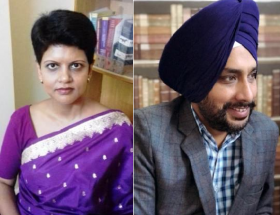

Saraswati Suna (Swati)
Abstract: Marriage rituals in South Asia have historically reinforced caste and gender hierarchies. Within contemporary Ambedkarite Buddhist communities in Odisha, debates over “mixed marriages” frequently centre on visible Hindu practices such as Brahmin priests, sindur, and the mangalsutra. Drawing on Ambedkarite social media discussions, wedding practices, B. R. Ambedkar’s writings, and anthropological studies of marriage, this article argues that such critiques are often selective. While many Ambedkarites reject Brahmanical symbols, they continue practices such as the baraat, engagement rituals such as Nadia Dhara (ring ceremonies), status matching in partner selection, and competitive wedding display. These practices reproduce caste, gender, and status hierarchies in new forms. This article argues that Ambedkarite Buddhist marriage remains an evolving social project. Its transformative potential depends on changing the social relations that organise marriage, not simply replacing Brahmanical symbols. It calls on Dalit Bahujan communities to reimagine Buddhist marriage as an ethical practice grounded in equality, solidarity, and collective uplift.
Introduction: Hindu marriage has often been understood as a religious and soteriological event embedded within broader moral and ritual frameworks (Harman, 1987). At the same time, marriage has historically operated as a key social institution through which caste, gender, and hierarchy are regulated and reproduced (Ambedkar, 1916/1979). As Ambedkar argued, the endurance of caste rests significantly on the regulation of marriage, particularly through endogamy and the control of women’s mobility and sexuality. Rituals surrounding marriage are therefore not incidental cultural practices but central mechanisms through which social order is maintained, reproduced, and publicly displayed.
However, marriage also carries the potential for transformation, especially within communities committed to equality and social justice. In the context of Ambedkarite marriage, it becomes a critical site for practising dignity, equality, and mutual respect. At the same time, inherited caste and patriarchal structures can continue to persist in new forms within intimate relationships. It is within this tension between reproduction and transformation that the significance of marriage must be understood. For Ambedkar, challenging caste required transforming both political institutions and everyday social practices that maintain caste boundaries.
The mass conversion to Buddhism in 1956 formed part of this broader social project. Conversion signified a rejection of Brahmanical religious authority, and an embrace of an ethical framework based on equality and rationality (Ambedkar, 1957). Yet the question of how marriage is practised within Ambedkarite communities remains open.
In recent years, debates within Ambedkarite circles in Odisha have increasingly focused on what many describe as “mixed marriages.” The term refers to weddings that identify themselves as Buddhist while simultaneously incorporating rituals and practices associated with Hindu traditions. These include the presence of Brahmin priests, Sanskrit mantras, fire rituals, dowry exchanges, and engagement or practices such as kanyadaan and the symbolic “gift of the daughter.” In many marriages, families also continue to rely on astrology through kundali matching and the selection of an auspicious muhurat, practices that shape ideas of compatibility, timing, and ritual legitimacy. Ambedkarite activists and commentators often criticise these practices because they reproduce Brahmanical structures of caste, thereby weakening the emancipatory potential of Buddhist marriage. Such critiques frequently draw upon Ambedkar’s analysis of caste, endogamy, and the social regulation of marriage, and emphasise that ritual reform is central to the broader project of annihilating caste.
However, contemporary discussions also reveal an important asymmetry. While explicitly Hindu ritual elements are strongly criticised, other practices common within Ambedkarite weddings receive little scrutiny. One such practice is the baraat, the celebratory procession in which the groom travels to the bride’s home accompanied by music, dancing, and relatives. This article examines why certain rituals become objects of critique while others remain normalised within Ambedkarite communities in Odisha. I argue that critiques of “mixed marriage” tend to focus on visible and easily identifiable symbols rather than the deeper social structures embedded in ritual practice. As a result, while overtly Brahmanical elements are rejected, underlying patterns of caste and gender hierarchy often remain insufficiently examined.
This paper examines contemporary Ambedkarite debates on marriage in Odisha, focusing on caste, gender, Hindu marriage norms, and Ambedkarite alternatives. While marriage as a social institution requires further exploration, future research will examine its relationship with patriarchy, caste, gender, and social transformation across diverse communities and caste and religious traditions.
This article is structured as follows. This article begins with a methodological and positional note, followed by anthropological perspectives on marriage and Ambedkar’s understanding of caste and endogamy. It then examines the historical background of the baraat. Then it discusses contemporary Ambedkarite debates on ritual reform, gender, status matching, and wedding display. The final section argues that Ambedkarite marriage remains an evolving ethical and social project.
Methodological and Positional Note
This article adopts an interpretive and reflexive approach to contemporary Ambedkarite marriage practices in Odisha, combining anthropological reflection with engagement in Ambedkarite social worlds. The analysis does not present a formal ethnographic field study based on structured interviews or systematic participant observation. The discussion draws on observations of Ambedkarite wedding ceremonies in parts of Odisha, as well as conversations and debates circulating on social media platforms and community networks, where questions surrounding “mixed marriages” are actively negotiated.
As a native of Odisha and an Ambedkarite observer, my engagement with these practices is both experiential and analytical. This positionality allows close attention to the everyday ways in which rituals are performed, interpreted, defended, and contested within the community. At the same time, the article does not claim neutrality or complete externality from the social world being analysed. In this sense, the paper is informed by a reflexive sociological orientation (Bourdieu & Wacquant, 1992), recognising that the social and intellectual worlds also shape the observer under examination. This approach also reflects a broader anthropological recognition that contemporary debates over ritual, morality, and identity are increasingly mediated through digital platforms and informal discussion networks. This article presents a theoretically informed interpretation of patterns that are socially visible, widely discussed, and culturally significant within Ambedkarite contexts in Odisha.
Observing Ambedkarite Public Discourse
Social media platforms, especially Facebook and Instagram, have become important arenas where Ambedkarites share wedding photographs, videos, and reflections. In these discussions, people often debate whether a ceremony was “properly Buddhist” or whether it included Hindu ritual elements. Criticism usually focuses on visible markers such as Brahmin priests, Sanskrit mantras, fire rituals, dowry, or kanyadaan. These elements are interpreted as signs that the ceremony remains shaped by Brahmanical traditions. Many Ambedkarites frequently invoke Ambedkar’s critique of caste and stress that Buddhist weddings should reflect anti-caste values.
Scholars of digital anthropology note that social media increasingly functions as a space where communities negotiate identity, morality, and cultural norms through everyday interaction (Miller et al., 2018). Alongside these digital observations, I also attended and closely observed a Buddhist wedding within an Ambedkarite community in Odisha. Conversations surrounding the ceremony reflected similar concerns about avoiding Hindu rituals and preserving Buddhist ethical principles. Yet the baraat procession remained one of the most celebrated and emotionally charged moments of the wedding. The groom’s arrival, music, dancing, and symbolic display generated collective excitement and pride. This article focuses on this tension: while some rituals are identified and criticised as Brahmanical, the baraat and other rituals continue to be normalised as culture, celebration, and Ambedkarite assertion. In many contemporary Ambedkarite weddings, the baraat has become a central spectacle of identity, prestige, and public performance.
The Historical Background of the Baraat
Classical Hindu texts reflect the patrilineal logic underlying many South Asian marriage systems. The Manusmriti, for example, places women under the authority of father, husband, and son, while kanyadaan symbolically transfers the bride into her husband’s lineage (Doniger & Smith, 1991). This text does not describe the contemporary baraat. Rather, they illustrate the broader social structure of patriliny and bride transfer that later marriage rituals came to express in different ways.
The contemporary baraat is a much later historical development. It became widely established during the nineteenth and twentieth centuries (c. 1800–2000), when wedding processions associated with royal and dominant-caste marriage practices spread across many caste communities through social mobility, colonial modernisation, and urbanisation. As the procession became more widely adopted, it came to publicly enact kinship alliance and patrilocal marriage. The groom travels with relatives, music, and celebration to the bride’s household, marking the alliance between families and the incorporation of the bride into the groom’s lineage (Selwyn, 1979). The procession also has historical connections to royal and martial culture. In premodern South Asia, horses symbolised sovereignty, masculine prestige, and warrior authority. Mounted processions, in which rulers and elite men rode on horseback during public ceremonies, were associated with kingship and high social status (Richards, 1978). Meadows (2013) similarly argues that horseback display functioned as a marker of embodied masculinity and social distinction. Over time, these elite forms of ceremonial display became incorporated into wedding rituals through the groom’s mounted procession.
Anthropological Perspectives on Marriage
Ambedkar’s early writings themselves constitute an important anthropological and ethnological analysis of caste, gender and marriage. In Castes in India, he argued that caste survives through endogamy and the regulation of marriage (Ambedkar, 1916/1979). Marriage rituals, therefore, are not politically neutral cultural practices but central mechanisms through which caste and gender hierarchy are reproduced and maintained.
Anthropological studies show that South Asian marriage is structured through unequal relations between wife-givers and wife-takers. Lévi-Strauss (1969) viewed marriage as a system of exchange that organises kinship alliances, while Selwyn (1979) argues that these rituals reproduce a social order in which honour and authority are associated with men, wife-takers, and higher-status groups, and women and wife-givers occupy subordinate positions.
Ethnographic research from Khalapur further found that Rajput weddings were procedurally “almost the same” as those of Brahmins and Dalit communities such as Chamars and Chuhras (Kolenda, 1984, p. 99). This suggests that hierarchical marriage forms are widely reproduced through social imitation and cultural continuity. From this perspective, the baraat is more than a celebration. It embodies masculine prestige, lineage, and caste hierarchy, yet it has rarely been questioned within contemporary Ambedkarite debates.
Baraat, Caste Prestige, and Dalit Exclusion
The baraat, particularly the groom riding a horse and sometimes carrying a sword, has long been associated with dominant-caste and warrior traditions in South Asia. For Dalits, however, such displays were historically restricted (Khandekar & Majumdar, 2026). In several parts of India, Dalit grooms have faced threats, humiliation, violence, and even murder for riding horses during wedding processions because the act was seen as a challenge to caste hierarchy. Contemporary incidents across North and Western India show that the mounted baraat remains a visible marker of dignity, status, and caste assertion (Khandekar & Majumdar, 2026). In this context, a Dalit or Ambedkarite groom riding a horse can represent a powerful assertion of dignity against historical exclusion. Yet this assertion does not automatically dismantle the hierarchical meanings embedded in the ritual. Does adopting the baraat represent liberation, or does it reproduce the social structures that anti-caste politics seeks to transform?
The political logic of the Kalaram Temple Entry Satyagraha, led by Ambedkar on 2 March 1930, offers an important way to think about this tension. Ambedkar’s entry into the temple did not affirm Hindu worship; it asserted equal rights and human dignity. Likewise, a Dalit groom riding a horse may challenge historical exclusion. However, this does not require preserving the baraat as a whole. Equality can be claimed without reproducing the caste hierarchy and patriarchal choreography through which the ritual historically acquired its meaning. Assertion, therefore, need not entail repetition.
Reimagining Buddhist Marriage: Between the Annihilation of Caste and Dhamma
If marriage reproduces caste, as Ambedkar argued (see ” Caste in India: Their Mechanism, Genesis and Development”), then the question is how marriage should be reimagined within an Ambedkarite Buddhist framework. In The Buddha and His Dhamma, Ambedkar presents Buddhism not as a religion of ritual but as a moral and social philosophy grounded in liberty, equality, and fraternity. Rather than prescribing a fixed model of marriage, he offers ethical principles through which marriage can be rethought beyond caste hierarchy and patriarchal control. From this perspective, Buddhist marriage cannot simply mean replacing one set of rituals with another. It requires transforming the social relations through which caste and patriarchy are reproduced. Marriage must be grounded in equality, dignity, compassion, and shared responsibility rather than lineage, hierarchy, or control. The emphasis shifts from ritual performance to ethical relationships and everyday social practice.
This understanding also strengthens the critique of contemporary Ambedkarite marriage practices. Rejecting visible Brahmanical symbols alone is not enough if marriage continues to reproduce hierarchy through everyday practices. The absence of a fixed Buddhist marriage model should therefore be understood not as a limitation but as an opportunity. It invites each generation to develop marriage practices that reflect the anti-caste vision of Annihilation of Caste and the ethical principles of The Buddha and His Dhamma. In this sense, Ambedkarite Buddhist marriage remains an evolving project of ethical and social transformation.
Selective Ritual Critique and the Persistence of the Baraat
Contemporary Ambedkarite debates on “mixed marriages” rarely question the baraat. Instead, criticism usually targets visible Hindu practices such as Brahmin priests, sindur, mangalsutra, or dowry. Yet these critiques are often selective. Many weddings appear Buddhist in form while continuing practices such as the baraat, kanyadaan, or large-scale economic expenditure. The issue, therefore, is how social relations and hierarchies continue to organise marriage.
Ambedkar (1916/1979) argued that caste reproduces itself through endogamy, imitation, and the habitual observance of inherited customs and social practices. Bourdieu’s concept of habitus (1977) further explains how these practices become internalised through everyday life until they appear natural and self-evident. Ethnographic observations from North India support this argument. Kolenda (1984, p. 99) found that Rajput weddings were procedurally “almost exactly the same” as those among Brahmins and Dalit communities such as Chamars and Chuhras, showing how ritual forms are reproduced across communities through social imitation and cultural continuity. This helps explain why the baraat remains largely unquestioned in many Ambedkarite weddings in Odisha. Its dominant-caste origins are often recognised, yet the ritual continues to be celebrated. Celebration, status, and emotional attachment make the procession difficult to question. The festive atmosphere obscures the unequal social relations embedded within the ritual, allowing caste and patriarchal relations to persist through everyday practice.
Selective critique also operates within Ambedkarite communities themselves. Individuals with greater symbolic authority often shape what counts as a “proper” Ambedkarite marriage. Yet similar inconsistencies appear across generations. Even some first- and second-generation educated Ambedkarites who strongly criticise Brahmanical rituals have themselves celebrated weddings with baraat processions, sindur, dowry, or lavish wedding expenditure. In some cases, they have publicly criticised or even refused to attend the weddings of fellow Ambedkarites, describing them as “Brahmanical,” while overlooking similar practices in their own marriages. This produces an uneven politics of ritual reform in which certain rituals become markers of ideological purity, while others remain protected by emotional attachment, patriarchal privilege, cultural familiarity, or symbolic prestige. This unevenness is also gendered. Rituals associated with women become the primary targets of ideological scrutiny, while male-centred practices such as the baraat remain largely unquestioned. Critique, therefore, reflects not only ideological disagreement but also unequal relations of gender, recognition, legitimacy, and symbolic power within the movement.
At the same time, these practices are not static. Many Ambedkarite weddings consciously reshape the baraat through new political symbols. Grooms carry portraits of Ambedkar, blue flags accompany the procession, and Ambedkarite songs replace conventional wedding music. These practices express Dalit dignity, assertion, and public visibility in a society that historically denied such recognition. Yet an important question remains. Does adding Ambedkarite symbols transform the social structure of the ritual, or does it place new political meanings onto an inherited ceremonial form? If the procession continues to centre masculine mobility, lineage assertion, and the asymmetrical incorporation of the bride into the groom’s family, then its underlying social logic may remain largely intact. The Ambedkarisation of the baraat therefore illustrates the continuing tension between symbolic assertion and structural transformation within contemporary Ambedkarite marriage practices in Odisha.
Beyond Sindur and Mangalsutra: Gender and Ritual Reform
Within Ambedkarite discussions, sindur and mangalsutra are frequently criticised as visible symbols of Brahmanical patriarchy and women’s subordination. Many Ambedkarite Buddhists reject these practices to distinguish Buddhist marriage from Hindu marriage and to assert a break from caste-bound ritual traditions. This rejection is politically significant. Yet an important question remains. Does removing these symbols transform the gendered structure of marriage?
Too often, reform takes the form of substitution rather than transformation. In many Hindu weddings, brides wear red sarees, red bangles, and marital ornaments. In some Ambedkarite weddings, these are replaced with white sarees, white bangles, and other Buddhist symbols. The colour changes. The religious reference changes. Yet marriage continues to be written onto the female body. The issue, therefore, is not whether women wear red or white. The deeper question is why women remain the primary bearers of marriage, community identity, and moral respectability. Dalit women have long been expected to uphold community honour and, increasingly, to visibly embody anti-caste reform through marriage rituals. Under Brahmanical patriarchy, women’s bodies became sites through which caste was reproduced. Within some anti-caste spaces, they continue to function as the primary sites through which reform is displayed.
When Ambedkarite communities reject sindur and the mangalsutra, do they free women from ritual marking, or do they assign women new forms of symbolic labour? If women are still expected to visibly embody marriage while men remain largely unmarked, then the gendered structure of marriage has not fundamentally changed. It has simply acquired a new political language. This is not an argument against Buddhist weddings or against rejecting Brahmanical symbols. Such refusals remain politically meaningful. The challenge is to move beyond symbolic substitution. Why should marriage be visibly marked on women’s bodies at all? Why is reform measured through women’s appearance rather than through transforming gendered relations? If anti-caste politics seeks the annihilation of caste, then marriage reform must also challenge the gendered division of symbolic labour. Women should participate in marriage as equal subjects, not as carriers of community identity or political transformation.
This critique also turns inward. A Dalit women Ambedkarite perspective does not question only Brahmanical traditions. It also asks anti-caste communities to examine how gendered expectations travel into spaces of reform. Liberation requires more than replacing symbols. It requires reimagining rituals, relationships, and marriage itself so that women are no longer expected to visibly embody reform. Instead, anti-caste transformation should be realised through transformed social relations rather than through the regulation of women’s bodies.
Ambedkarite Marriage: Between Collective Uplift and Status Matching
A deeper contradiction appears in contemporary Ambedkarite marriage practices. Ambedkarite ethics call for transforming social relations, including marriage. Yet partner selection often follows status matching. People may express a willingness to marry across marginalised Dalit sub-castes, but these positions often change over time. Many begin to seek partners who are more educated, socially respected, economically secure, or from higher-status backgrounds. Marriage thus becomes not a means of collective transformation but a strategy of individual mobility.
This shift is visible in everyday conversations. Some middle-class Dalit women seek highly educated or high-status Dalit men, or upper-caste men. Some educated Dalit men aspire to marry upper-caste women or middle-class Dalit women. In such cases, aspirations for upward mobility outweigh commitments to anti-caste solidarity. If everyone seeks to marry upward, where do the most marginalised go? When marriage becomes organised around education, class, and social status, those with fewer resources and greater social stigma face increasing exclusion. A process of social closure emerges. Marriage opportunities become concentrated among those who already possess educational, cultural, and economic advantages. The most marginalised, particularly women from poorer families and historically marginalised Dalit sub-castes, bear the greatest cost.
Even Ambedkarite marriage can therefore become a site of status reproduction. Preferences for status matching reproduce inequalities within Dalit communities and reflect what Ambedkar (1936) described as graded inequality. Hierarchy does not remain outside the community. It becomes internalised and shapes intimate decisions. Ideas of compatibility, respectability, and personal choice often conceal deeper assumptions about worth, status, and social mobility.
This pattern also raises important questions about the meaning of collective uplift. Ambedkarite politics has long emphasised the advancement of the community as a whole. If marriage primarily benefits those who already possess educational, cultural, and economic advantages, the ethical principle of lifting one another loses its force. Marriage becomes a mechanism through which inequality is reproduced rather than reduced.
Supporters of these patterns often invoke the language of inter-caste marriage, love marriage, and individual choice. Such marriages undoubtedly challenge important caste boundaries and often involve considerable social risk. Yet the question is not simply whether a marriage crosses caste boundaries. It is also which inter-caste marriages become desirable and celebrated. If they primarily facilitate upward social, educational, or economic mobility, then the language of choice may obscure continuing inequalities within marriage networks. The issue, therefore, is not whether inter-caste or love marriages are progressive. The deeper question is whether they advance the Ambedkarite ideal of collective uplift. If opportunities continue to concentrate among those who already possess social, cultural, and economic advantages, marriage will reproduce new forms of inequality within an anti-caste framework. The challenge is to examine not only the crossing of caste boundaries but also the distribution of opportunity, dignity, and recognition within the community itself.
Ambedkarite Marriage and the Political Economy of Contemporary Wedding Display
A further contradiction emerges in contemporary Ambedkarite marriage practices. Many Ambedkarites challenge caste hierarchy, Brahmanical patriarchy, and social inequality in public life. Yet marriage often remains a domain where these commitments are only partially realised.
Many Ambedkarite weddings continue to resemble upper-caste models of celebration. Displays of gold, elaborate decorations, professional photography, multiple ceremonies, and expensive wedding attire have become increasingly common. Within the community, such weddings are sometimes jokingly compared to the lavish celebrations of the Ambani family. Behind the humour lies a broader sociological pattern. Weddings increasingly function as arenas of competitive status display. Brahmanical ritual symbols may disappear, yet prestige and distinction remain central to the celebration. If Ambedkarite weddings continue to reproduce upper-caste ideals of status and display, in what sense do they represent a different model of marriage? The issue is especially significant for poorer and more marginalised families. Rising wedding expenditure creates standards that many cannot realistically meet. Those with greater economic resources gain visibility and prestige, while those with fewer resources face increasing exclusion. Such practices resemble what Veblen (1899) described as conspicuous consumption and what Bourdieu (1977) analysed as distinction. Weddings become occasions for displaying economic success as much as celebrating marriage. What appears as celebration can also reproduce inequality within the community.
The challenge facing Ambedkarite communities therefore extends beyond removing Brahmanical rituals. It requires transforming the social values that organise marriage itself. Ambedkar (1936) described caste as a system of graded inequality in which each group seeks relative superiority. That logic can survive conversion, education, and political consciousness through everyday aspirations and status practices. The question, therefore, is not simply whether a wedding appears Hindu or Buddhist. It is whether marriage strengthens collective solidarity and mutual uplift or reproduces new forms of hierarchy within the community.
The Absence of a Standard Buddhist Marriage Model
There is no universally standardised Buddhist marriage model within the Ambedkarite tradition. Following the mass conversion movement of 1956, Ambedkarite marriages can be developed through diverse regional and community practices rather than a fixed ritual code. Ambedkar did not seek to prescribe every aspect of marriage. In a letter to V. S. Kardak dated 4 December 1956, he outlined a simple Buddhist marriage ceremony. He rejected homa and saptapadi and prescribed an earthen pot, a shared cotton thread, the recitation of the Mangala Sutta, and white clothing for both bride and groom. His support for legal and civil marriage also pointed towards separating marriage from Brahmanical ritual authority.
Ambedkar’s letter should be read as a proposal for a simple Buddhist marriage ceremony rather than a comprehensive blueprint for Buddhist marriage. It offered practical guidance while leaving future generations to reinterpret marriage in light of Ambedkarite ethics and changing social realities. This question becomes particularly significant in rural Dalit communities, where marriage is experienced not simply as a legal union but as a collective social institution that creates kinship, reciprocity, community recognition, and belonging. The challenge, therefore, is to develop forms of marriage that embody anti-caste ethics while remaining meaningful in different social contexts.
Contemporary Ambedkarite weddings therefore combine Buddhist recitations with locally familiar customs. These hybrid forms reflect continuing efforts to reinterpret marriage within an Ambedkarite ethical framework. Debates surrounding “mixed marriages” illustrate this ongoing process. Some inherited Hindu practices are criticised, while others remain largely unquestioned. Rather than representing a fixed ritual tradition, Ambedkarite marriage remains an evolving social project shaped through reflection, debate, and collective experimentation.
Conclusion
Debates over “mixed marriages” and the continued practice of the baraat reveal important tensions within contemporary Ambedkarite marriage practices in Odisha. Many Ambedkarites reject Brahmanical rituals such as Sanskrit mantras, Brahmin priests, sindur, and the mangalsutra. Yet practices such as the baraat, status matching through social closure, and competitive wedding expenditure often remain largely unquestioned. These practices reproduce masculine prestige, social distinction, and new forms of inequality within the community. They also narrow marriage opportunities for the most marginalised, particularly women, challenging the Ambedkarite commitment to collective uplift.
This paper has argued that the question is not simply whether a marriage appears Hindu or Buddhist. The deeper question is whether marriage transforms the social relations through which caste, patriarchy, status, and inequality are reproduced. Ambedkarite marriage should therefore be understood not as a completed ritual tradition but as an unfinished social and ethical project. Its transformative potential depends on the willingness of Ambedkarite communities to critically examine inherited practices and to imagine new forms of marriage that embody equality, dignity, and collective responsibility.
References
Ambedkar, B. R. (1957). The Buddha and his dhamma.
Ambedkar, B. R. (1979). Castes in India: Their mechanism, genesis and development. In V. Moon (Ed.), Dr. Babasaheb Ambedkar: Writings and speeches (Vol. 1, pp. 3–22). Government of Maharashtra. (Original work published 1916)
Ambedkar, B. R. (1936/2014). Annihilation of caste. Navayana.
Ambedkar, B. R. (1956, December 4). Letter to V. S. Kardak on the Buddhist marriage ceremony. Reproduced in Dr. Babasaheb Ambedkar: Biography (Vol. 12). Government of Maharashtra. http://ambedkarletters.com/
Bourdieu, P. (1977). Outline of a theory of practice. Cambridge University Press.
Doniger, W., & Smith, B. K. (Trans.). (1991). The laws of Manu. Penguin Books.
Harman, W. (1987). The Hindu marriage as a soteriological event. International Journal of Sociology of the Family, 17(2), 169–182.
Khandekar, V., & Majumdar, A. (2026). Crisis and rescue mechanism of hegemonic masculinity in Northern India: Caste, horses and kings. Masculinities & Social Change, 15, 1–20. https://doi.org/10.17583/mcs.14629
Kolenda, P. (1984). Woman as tribute, woman as flower: Images of “woman” in weddings in North and South India. American Ethnologist, 11(1), 98–117.
Lévi-Strauss, C. (1969). The elementary structures of kinship (J. H. Bell, J. R. von Sturmer, & R. Needham, Trans.). Beacon Press. (Original work published 1949)
Meadows, M. (2013). The horse: Conspicuous consumption of embodied masculinity in South Asia, 1600–1850 [Master’s thesis, University of Washington]. University of Washington ResearchWorks. https://digital.lib.washington.edu/researchworks/items/041762d0-2ee3-47e8-bef8-b5e94d0d3020
Miller, D. (2023). Digital anthropology. In F. Stein (Ed.), The Open Encyclopedia of Anthropology. https://doi.org/10.29164/18digital
Richards, J. F. (Ed.). (1978). Kingship and authority in South Asia. University of Wisconsin–Madison.
Selwyn, T. (1979). Images of reproduction: An analysis of a Hindu marriage ceremony. Man, 14(4), 684–698.
~~~
Dr. Saraswati Suna (Swati) is a sociologist and Dalit feminist ethnographer from Odisha. Her research examines educational institutions, caste, gender, and social inequality, with a particular focus on institutional reproduction and unequal life chances.