Mahesh Admankar
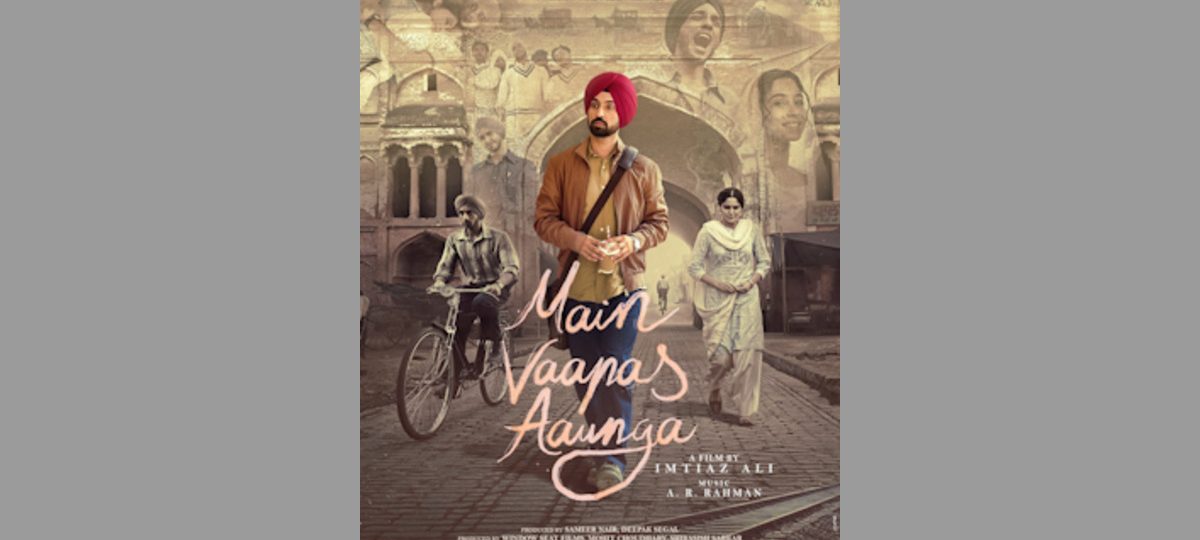
Main Wapas Aavunga is an emotionally resonant masterpiece—one that approaches the staggering tragedy of the 1947 Partition not through explosive political grandstanding, but through the quiet, devastating power of human intimacy. The film anchors the historical trauma of millions onto the fragile shoulders of an elderly Sikh man in his nineties. Haunted by memories of a lost Muslim love and an ancestral home, his grief becomes a bridge connecting the soil of undivided Punjab to a modern diaspora, embodied by his devoted grandson.
Cinematically, the film transforms historical pain into visual poetry. Yet beneath its lyrical aesthetic, the film conspicuously sidesteps the caste question. It fails to acknowledge how disproportionately marginalized, lower-caste communities bore the structural and physical brutalities of the migration. To address this gap, this article examines the film through an Ambedkarite lens, unearthing the silences hidden beneath its beautiful, diasporic nostalgia.
Directorially, Main Wapas Aavunga avoids sensationalizing violence, letting silence, longing, and memory carry the emotional weight. The visual language is arresting: a soft, warm palette for pre-Partition Punjab contrasts sharply with the stark, modern isolation of the contemporary sequences.
Poetry and music serve as the true heartbeat of the narrative, elevating the film from period drama to lyrical elegy. The soundtrack does not dictate emotion but cradles it, using traditional Punjabi cadences and aching pauses to convey decades of suppressed grief. The elderly protagonist delivers an extraordinary performance—a masterclass in understatement, in which a simple gaze or a trembling hand speaks volumes about displacement. The screenplay asks whether borders can erase emotional connections, crafting a universal longing for belonging that transcends nationality and religion. This is a film that earns its tears through genuine, earned sensitivity.
Yet, even as we celebrate this artistic triumph, a deeper reading reveals that the film’s emotional canvas could have been richer had it engaged with the era’s structural realities. The film portrays the border as an unexpected, tragic act of fate. Historical reality, however, suggests otherwise: the catastrophic breakdown of safety was the direct result of a top-down, rushed political transaction that left ordinary citizens unprotected. Partition is framed as a sudden disruption to ordinary lives, but the film minimizes how the absence of organized state safeguards facilitated the chaos.
The film captures the longing for “home,” but it follows a protagonist whose family possessed the resources to eventually build a life extending to London. By focusing on this singular, privileged experience, the narrative inadvertently glosses over the precarious reality of marginalized communities along those same borders. Without a safe, organized transition, the arbitrary line drawn through mixed communities disproportionately trapped those without economic mobility, turning neighbors against one another. By treating displacement as a uniform tragedy, the film masks how deeply wealth and resources determined one’s ability to survive. The film would have been more inclusive—and historically authentic—had it incorporated the layered struggles of marginalized castes and women. While the film handles the separation of upper-class lovers with romantic tenderness, it stops short of depicting the raw, terrifying gendered and caste-based politics of Partition.
Historically, the refugee experience was deeply stratified. During the chaos, women’s bodies became battlegrounds of communal “honour.” Tens of thousands were subjected to abduction, mass rape, and forced conversion as instruments of political subjugation. Marginalized women faced a double jeopardy—stripped of both physical safety and societal protection, viewed as community property rather than individuals. The film’s romantic lens replaces this systematic violence with a sanitized narrative of lost love, bypassing the horrors endured by women on both sides of the border.
While dominant-caste families faced grief and land loss, Scheduled Caste Sikhs and Dalit sanitation workers were often legally and physically barred from escaping the violence. Their manual labour was deemed essential to the infrastructure of newly formed cities; they were virtually held in state-enforced bondage while others fled. Those at the bottom of the social pyramid bore the most violent brunt of communal fury, defenseless against roaming mobs. Even those who crossed into safety frequently encountered systemic exclusion and discrimination within the relief camps meant to protect them.
Watching the grandson in Main Wapas Aavunga trace his family’s displacement struck a deeply personal chord, illuminating the undocumented migration of my own family. My grandparents were uneducated, impoverished, and structurally deprived individuals forced to migrate from present-day Maharashtra into Telangana, and later pushed further into another district. As migrants, they faced a double jeopardy: material hardship alongside persistent “othering” and hostility in a village that viewed them as perpetual outsiders. This precariousness was compounded when our official caste classification shifted from Dalit to OBC—a bureaucratic stroke that fundamentally altered our access to institutional support and state welfare.
In the absence of institutional safety, it was the local Muslim community and other marginalized groups who stepped in, offering vital support that allowed my grandparents to survive. Today, as their grandson—a first-generation scholar in the United States—I find myself the repository of these inherited memories. I am piecing together the structural violence, geographic uprooting, and forgotten history of my great-grandparents. My trajectory from those hostile rural spaces to a research fellowship in the US was never a linear probability; it was paved by the radical educational access and tools of empowerment forged by Dr. B.R. Ambedkar, Mahatma Jyotirao and Savitribai Phule, and the Bahujan Revolutionaries. Their legacy turned the generational silences of my family into a tool of critical inquiry, allowing a grandson of displaced labourers to write these words today.
In contemporary India, where discussions of historical memory, borders, and national identity remain highly charged, Main Wapas Aavunga serves as an invaluable cultural touchstone. It gently reminds us that history must be understood through human emotion rather than political rhetoric alone. The intergenerational impact of trauma—portrayed through the grandson’s journey—underscores how the scars of 1947 continue to shape modern identities.
Yet its ultimate lesson is that our empathy must be expansive. A complete understanding of Partition requires remembering not only the separation of lovers and loss of ancestral lands, but also the silent, ongoing struggles of the most vulnerable survivors—stories that rarely receive the cinematic grandeur they deserve. In an era where singular narratives of community trauma are often leveraged for political polarization, an inclusive historical perspective is crucial for recognizing the internal hierarchies of suffering.
Main Wapas Aavunga is a magnificent achievement—a deeply affecting, beautifully rendered film that lingers long after the credits roll. Its subtle performances, restraint, and evocative use of silence allow personal relationships to carry history’s emotional weight with grace. Yet it leaves a notable thematic void by not addressing the layered, gendered, and material vulnerabilities of more marginalized refugees. Even so, it remains an essential, breathtaking tribute to love, memory, and the enduring human spirit.
AI Use Disclosure: Artificial intelligence tools were used solely for grammatical correction and language clarity by the author.
~~~
Mahesh Admankar is a Researcher in Policy, University of Massachusetts Boston, USA.