Amar K Babu
What Mayasabha presents as drama is in fact propaganda. It is not a fearless portrayal of caste politics, but a calculated narrative that silences the oppressed and sanctifies upper-caste power.
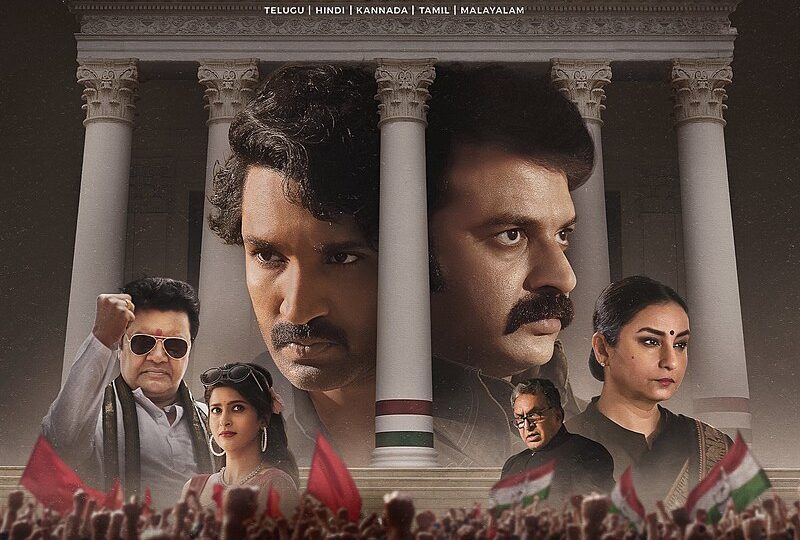
Mayasabha, marketed as a bold political web series on caste and power in Andhra Pradesh, arrives with grand claims: an exposé on the rise of political titans, a fearless portrayal of caste politics, and a fictional retelling of modern Andhra history.
Yet behind the grand sets and powerful performances lies a dangerous narrative. Instead of amplifying the voices of the oppressed, Mayasabha normalizes upper-caste domination, caricatures Dalit leadership, and desecrates the spirit of Ambedkar by twisting his imagery into one of fear, blood, and futility. This is not simply a cinematic misstep—it is a political statement disguised as entertainment.
A Symbol of Hope Made Into a Prop of Fear
One of the most troubling scenes unfolds around the statue of Ambedkar. A Dalit youth, driven to desperation and turned Naxalite, executes politicians and policemen in broad daylight. The camera first lingers on Ambedkar’s statue—as though invoking the promise of justice—but then abruptly shifts. From the feet of the statue, the shot cuts to a gunny bag of severed heads, placed at the feet of the youth as he sits in the front of a moving jeep.
The visual language is chilling: instead of framing Ambedkar as a beacon of justice and awakening, the sequence is reduced to a backdrop of blood and fear. Ambedkar becomes associated with chaos, not with education, justice, or liberation. This grotesque inversion erases the philosophy of Educate, Agitate, Organize and replaces it with terror.
This is not accidental symbolism. Cinema is politics by other means, and here Mayasabha uses Ambedkar not to inspire but to frighten. The whisper is unmistakable: “This is what happens when Dalits resist.”
The Mockery of Dalit Politicians
Throughout the series, Dalit politicians are painted with one brush: weak, submissive, opportunistic, or drunken.
- A Dalit Chief Minister is shown as a puppet, groveling before upper-caste masters.
- Other leaders are caricatured as incompetent or intoxicated.
- Their rise is framed not as the fruit of struggle, but as an accident of circumstance—something the “real leaders” tolerate for a time.
Meanwhile, the two central figures—thinly veiled versions of Reddy and Kamma leaders—are portrayed as charismatic, principled, and even noble in their rivalry. Their friendship across party lines is romanticized as statesmanship, while Dalit leadership is mocked as laughable.
This is not representation. It is ridicule.
Normalizing Upper-Caste Domination
The show reduces caste politics to a chessboard controlled by two dominant castes. Dalits and other oppressed groups appear only as props—spectators at best, placeholders at worst.
By portraying Reddy and Kamma leaders as “friends in rivalry,” Mayasabha legitimizes their domination as natural, inevitable, even admirable. The oppressed majority are denied history, agency, and dignity.
Ambedkar warned us long ago: “Caste is not merely a division of labour. It is a division of labourers.” By erasing Dalit assertion, Mayasabha perpetuates this graded inequality on screen.
The Fear Narrative: Revolt Equals Death
The Naxalite subplot is particularly manipulative. An innocent brother, forced into rebellion, takes up arms. But his fate is sealed—blood, fear, and eventual erasure.
The moral is made explicit: revolt will be crushed. Resistance leads only to death. This narrative kills hope before it can take root. It denies the possibility of democratic struggle, constitutional assertion, or Ambedkarite politics.
In a land where Dalits still fight daily battles for land, dignity, and representation, this is not just lazy storytelling—it is cruelty.
Historical Distortion and Political Messaging
Though borrowing heavily from Andhra’s political history, the series sanitizes and glorifies upper-caste leaders while delegitimizing Dalit struggles.
- The Emergency, caste wars, and crises are reframed as stages for upper-caste resilience.
- The oppressed are not given history; they are given humiliation.
- Justice is replaced with inevitability; struggle with submission.
Mayasabha ultimately feels like it was made by the upper caste, for the upper caste, about the upper caste.
Why This Matters
Cinema is never neutral. In a state where caste violence is still lived reality, where Dalit activists are silenced, and where Ambedkar’s vision remains unfulfilled, portrayals like Mayasabha shape collective memory.
When Dalit leaders are mocked as drunkards, when Ambedkar is framed alongside severed heads, when revolt is shown only as futile—the message is clear: “Stay in your place.”
That is not art. That is propaganda.
Conclusion: A Call for True Representation
Mayasabha is more than a web series—it is a mirror. But instead of reflecting truth, it projects illusion. It tells us power belongs only to a few, revolt leads only to blood, and the oppressed must remain caricatures in the theatre of politics.
This is not just cinema; it is conditioning. When art repeatedly normalizes domination and ridicules resistance, it trains society to accept injustice as destiny. That is its deepest betrayal.
Mayasabha could have been a landmark—an honest reckoning with caste, ambition, and power. Instead, it has become a spectacle of betrayal, reinforcing hegemony and undermining those it pretends to represent.
The true eye-opener is not the spectacle on screen but the silence it enforces. If politics is shown without the oppressed, it is not politics—it is theatre for the privileged. Until storytellers confront the raw reality of caste oppression, resistance, and hope, every grand assembly will remain what this series is: a sabha without its people.
~~~
Amar K Babu is a writer.