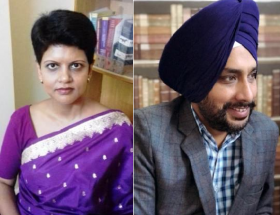

Dr Jas Simran Kehal
Not long ago, British historian Perry Anderson said that “To read Ambedkar is to enter a different world.” Now, when the whole world enters a different era – an era of Artificial Intelligence – does the century-old philosophy of Ambedkar carry forward its appeal in the era of Metaverse? Or will its essence change with the digital shift?
While presenting the constitution, Ambedkar had said that “On the 26th of January 1950, we are going to enter into a life of contradictions. In politics, we will have equality, but because our socio-economic structure continues to deny the principle of one man one value, we will have inequality in social and economic life.
Three-quarters of a century has gone by since Independence. India has risen to become the world’s fourth-largest economy, but still occupies 140th place in per-capita terms globally. It is time to confess that we have failed Ambedkar by disregarding his warning on economic and social democracy.
As India shifted from agrarian revolution to industrialisation, then computerisation, and later economic liberalisation, most of the benefits went to a few. As a recent editorial in this newspaper noted, global studies have ‘definitively linked declining trends in labour’s income share to technological advances — mainly automation and artificial intelligence. Today, as India enters an era of digitalised artificial intelligence, can we implement his ideas for society’s betterment? Or does his ideology risk being buried in the archives of history?
The future society controlled by AI stands at the danger of neo-oppressions like technological-casteism projected by algorithm bias, by hardcoding the historical prejudices into the future. This new invisible “caste bias” will not stem from historical scriptures but from data algorithms. It may extend beyond caste to gender, language, religion, ethnicity and even pin code. In the future, data could become the new currency, reducing the underprivileged to mere data points.
AI systems, because they are trained on historical data, often act as a mirror to society’s existing prejudices. It is this graded inequality that Ambedkar, the sociologist, unfolded, fought against, and legally penalised. His fight for equality, which started from the Mahad Satyagraha, is going to be more relevant in the times of the Metaverse. Ambedkar reclaimed physical spaces a century ago; now, his vision must reclaim the digital space.
In his magnum opus, Annihilation of Caste (1936), Ambedkar writes, “Turn in any direction; caste is the monster that crosses your path. You cannot have political or economic reform unless you kill this monster.” Thankfully, constitutional safeguards have been able to tame this monster to some extent on the ground level. But as the game shifts from real to virtual level, discrimination is likely to be difficult to diagnose, treat and cure. Artificial intelligence is liable to automate rather than annihilate caste.
The remedy for AI’s risks lies in Ambedkar’s ‘Constitutional morality.’ While UNESCO adopted AI ethics in 2021, we must infuse this code with consciousness to ensure the tech revolution benefits all humanity. Had previous modernization followed this moral compass, India’s per capita income would be far more equitable today.
An Ambedkarite audit for AI algorithms can help in eradicating discrimination in what is being apprehended as the digital caste system coming into being. Ambedkarite audit definitely does not mean merely posting Dalits on tech-development boards, but coding specific fail-safes against caste/gender based discrimination in future software. This type of audit may help bring down the probable bias in hiring, lending and even law enforcement. It will ensure transparency and make artificial intelligence go from smart to fundamentally just.
Historical injustice done by caste and gender bias in our society was treated by the doctor with the concept of baraabari, not bagaawat (equality rather than rebellion). Otherwise, world history does have umpteen examples of rebellions and revolutions. As we implement AI, society must heed his Constituent Assembly warning to abandon anarchy, evolving instead as a tool of trust, inclusion, and dignity of work, as ILO Director-General Gilbert F. Houngbo desires.
Although ‘scientific temper’ was later enshrined in Article 51A (h) of the Constitution, its roots lie in Ambedkar’s lifelong advocacy of science as a democratic tool. For AI to truly follow this path, it must prioritize inclusive innovation and public consciousness over mere computational efficiency, ensuring benefits reach the last person in line.
As India rushes to adopt AI, we must not leave Ambedkar in the 20th century. His one man one value concept can make AI a tool for social emancipation in a data-driven world. As he said, “Equality may be a fiction, but it must be accepted as a governing principle”
~~~
Dr. Jas Simran Kehal, MBBS, MS (Ortho), has an MA in Journalism and Mass Communication and an MA in Ambedkar Thought.