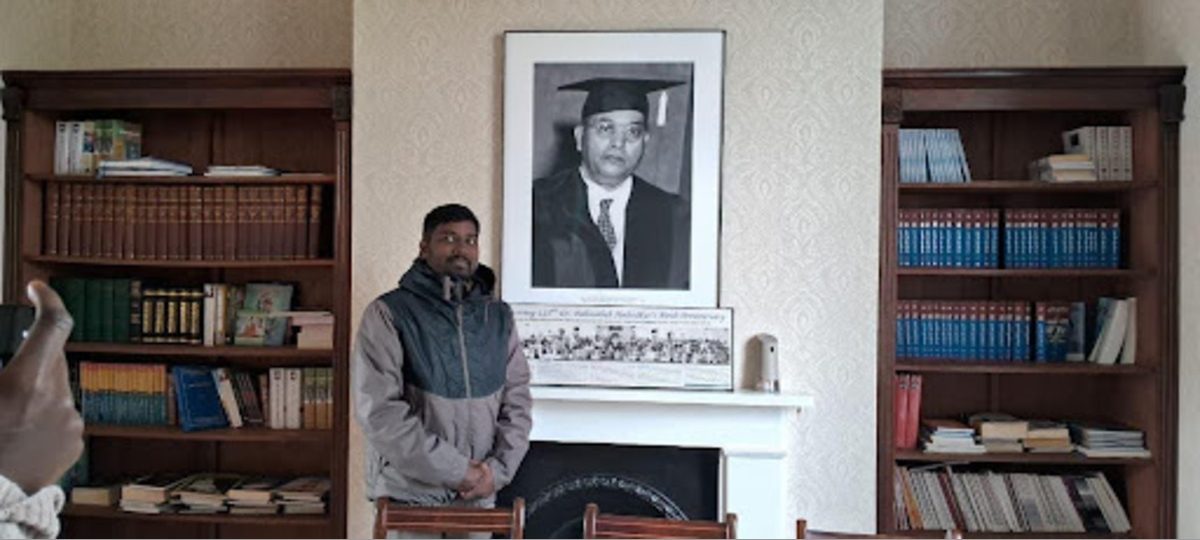
Thiruppathi P
From a village in Tamil Nadu to Ambedkar House in London, a first-generation scholar reflects on education, memory, and the unfinished struggle for equality.
“Cultivation of mind should be the ultimate aim of human existence.”
— B.R. Ambedkar
There are journeys measured in miles, and there are journeys measured in generations.
My recent journey to Ireland and the United Kingdom was an important moment in my academic life. As a doctoral researcher working on political communication, democracy, and regional political parties in India, I have had opportunities to present my research, engage with scholars, and visit universities. Yet among all these experiences, one stood apart: entering Dr. B.R. Ambedkar’s house in London.
For many visitors, it may be a historic building associated with one of India’s greatest intellectuals. For me, it was much more: a deeply personal encounter with a history that had made my own journey possible.
I come from Rangappanur, a small village in Tamil Nadu, and I am the first person from my family and village panchayat to pursue doctoral education. Growing up there, doctoral research, academic conferences, and international travel belonged to a world that seemed far beyond my reach. For me, as for many first-generation students from marginalized backgrounds, education has never been simply a path to employment. It has also been a path to dignity, confidence, and self-respect.
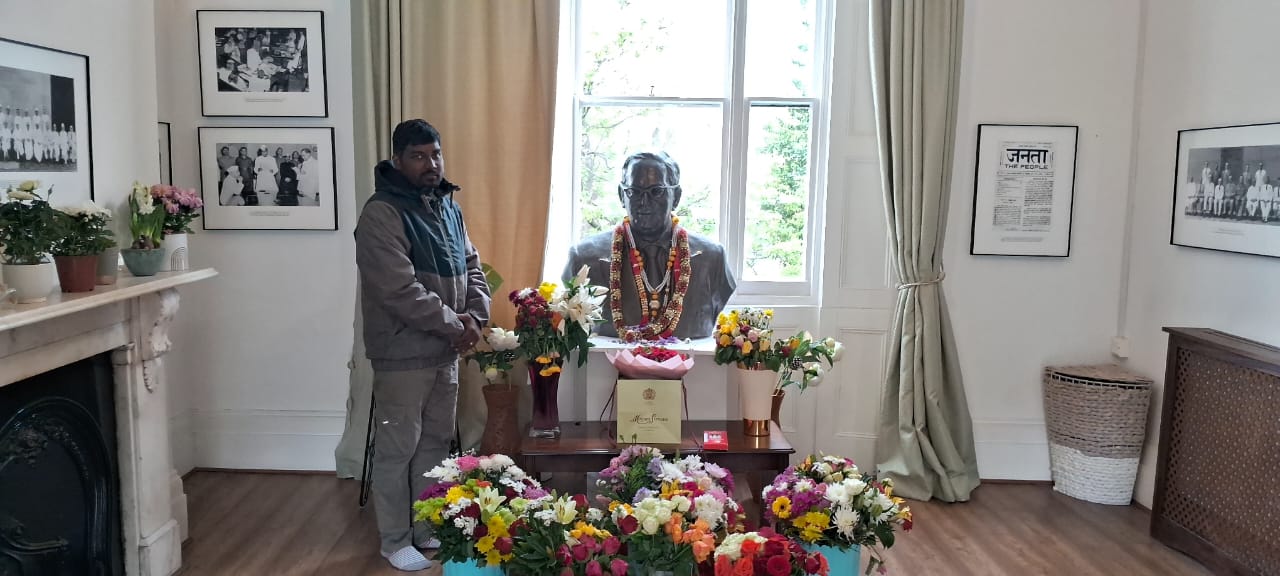
Standing inside Ambedkar House, I found myself unexpectedly emotional. For a few moments, I stopped thinking as a researcher and stood there. The room, the photographs, the books, and the knowledge that Ambedkar had once lived and studied there created a profound sense of connection across time. I thought about the barriers he had faced in pursuing education and about how his struggle had made journeys like mine imaginable. What I felt in that moment was deeply personal, but it also belonged to a much larger history of struggle, aspiration, and education as liberation.
Ambedkar’s educational journey cannot be understood simply as a story of academic achievement. As a child, he was denied access to drinking water at school because of his caste and was made to sit separately from other students. These were not isolated humiliations but expressions of a social order that sought to determine who could learn and who could not. Yet Ambedkar turned this exclusion into a relentless pursuit of knowledge.
When Ambedkar arrived in London, he was not merely a student seeking another degree. He was pursuing knowledge in a world that had once sought to deny him even the most basic dignity of a schoolchild. Despite financial hardship, he spent long hours in libraries and reading rooms, often sacrificing personal comfort to continue his studies. The knowledge he gained during these years would later shape his influential work on caste, democracy, economics, labour, and constitutionalism.
Preserving the homes of philosophers and thinkers allows one generation to encounter the intellectual lives of another. Such places become sites of public memory, reminding us that transformative ideas emerged from particular rooms, books, struggles, and circumstances. Ambedkar House carries this significance. Standing there made the history of his intellectual journey feel immediate and tangible in a way that reading about it alone could not.
As I reflected on Ambedkar’s life, one thought stayed with me. Dr. Ambedkar passed away in 1956. Nearly seventy years later, I became the first person from my family and village panchayat to pursue a Ph.D. I found this both inspiring and sobering. My journey would have been difficult to imagine without the struggles that Ambedkar and others carried forward. Yet, the time it took for someone from my background to reach doctoral education also reveals how slowly educational opportunity travels. The doors have opened, but many still take generations to reach them.
Yet my story should not be mistaken for evidence that educational inequality has disappeared. Many Dalit and marginalized students still face poor school infrastructure, unequal access to English and digital resources, social discrimination, limited academic support, and the absence of role models within their families or communities. For many first-generation learners, entering a university remains an extraordinary achievement rather than an ordinary expectation. This is why Ambedkar’s struggle for educational justice remains unfinished.
Reaching a university, however, does not always mean arriving at equality. Caste can continue to shape who feels included, who receives support, and whose presence is questioned within educational institutions. The tragic death of Rohith Vemula, and the debates on caste discrimination that followed, exposed a painful reality: access to higher education does not automatically guarantee dignity, belonging, or equal recognition.
Beyond universities, caste continues to shape access to land, employment, housing, and political power. The persistence of manual scavenging despite its legal prohibition, and continuing violence against the Scheduled Castes, shows the distance between constitutional equality and lived reality. Even digital technologies carry this contradiction. Social media has created new spaces for marginalized voices to speak, organize, and challenge exclusion, while also allowing caste prejudice to reappear in new forms.
Yet there are also reasons for hope. A new generation of Dalit scholars, writers, activists, journalists, and public voices is using universities, literature, law, and digital platforms to challenge inherited hierarchies. Their work shows that Ambedkar’s legacy does not live only in statues, memorials, or annual commemorations. It lives wherever people claim the right to speak, learn, participate, and be treated as equals.
As a researcher of political communication and democratic representation, I was particularly struck by Ambedkar’s understanding of the relationship between ideas and institutions. For him, democracy could not be sustained by elections alone; it required social equality, constitutional morality, informed citizens, and meaningful participation. His warning that political democracy would remain fragile without social democracy feels no less urgent today.
His famous call to “Educate, Agitate, Organize” was not merely a slogan; it was a programme for democratic transformation. Education made it possible to understand inequality, agitation turned that understanding into a demand for change, and organization gave collective strength to that demand. Read together, these three words capture Ambedkar’s belief that knowledge must lead beyond individual advancement towards collective freedom.
My own research examines how political parties communicate ideas of welfare, identity, and social justice. Yet my visit to Ambedkar House made me think about political communication in a wider sense. It is not only about messages, media, or election campaigns; it is also about who has access to knowledge, whose ideas enter public debate, and whose voices are heard. Ambedkar’s life reminded me that the democratization of communication begins with the democratization of knowledge.
The distance travelled by first-generation scholars is never geographical alone; it is also social, cultural, and historical. Entering spaces once denied to previous generations carries both the memory of that exclusion and the responsibility to widen the path for those who follow. Ambedkar’s own pursuit of knowledge was never only about changing his life; it was about changing the conditions under which millions of others lived.
To describe Ambedkar’s education simply as an escape from oppression is to miss its larger purpose. He pursued knowledge not only to transform his own circumstances but to challenge the conditions under which millions of others lived. His journey, therefore, asks something of those who follow: to see education not only as personal achievement, but also as a responsibility towards others.
When I left Ambedkar House that day, I carried with me a renewed sense of responsibility. The visit had made me think not only about how far I had travelled, but about the struggles that made such a journey possible and what I should do with the opportunities I have received.
My presence at Ambedkar House was therefore never mine alone. It carried the struggles of those who fought to make education and knowledge accessible to people historically excluded from them.
As India aspires to become a global knowledge society, one of Ambedkar’s central questions remains unresolved: who has access to knowledge, and under what conditions? The answer will shape not only the future of Dalits and other marginalized communities, but the quality of Indian democracy itself.
The distance Ambedkar travelled was extraordinary. The distance many of us still travel remains difficult. Yet every first-generation student who enters a university and every marginalized voice that finds space in public life shows that the journey continues.
Perhaps that is the true significance of Ambedkar House: it reminds us that the pursuit of knowledge is itself an act of democracy.
~~~
Thiruppathi P. is a Ph.D. Research Scholar at the Institute for Social and Economic Change (ISEC), Bengaluru. His research focuses on political communication, welfare politics, Dravidian ideology, democratic governance, and electoral communication in India.