Yasmin Soni
Shakespeare famously asked, “What’s in a name?” Well, dear Bard, if you were house hunting in Ahmedabad, the answer would be: everything. My name isn’t just a name; it’s a full-blown identity marker, a flashing neon sign that makes landlords pause, brokers cough awkwardly, and listings suddenly become “unavailable.”
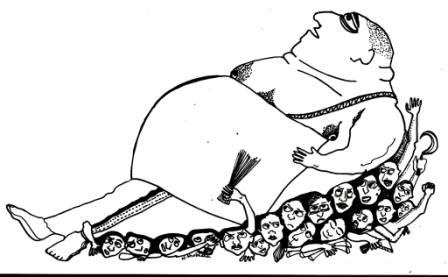
“Only Hindu.” “Non-veg not allowed.” “Boys not allowed.” “Alcohol party not allowed.” These statements repeatedly resonate in my mind and every phrase silently gatekeeping of who is welcomed and who is not. Each advertisement alongside each real estate agent’s phone call with every gentle yet resolute “No” reminds me that looking for a house is indeed much more than just a set of walls with a ceiling on top. It is about conforming to certain predefined criteria where your name, your food, your lifestyle, and your identity determine whether you can rent a space in the city.
Ahmedabad as most Indian cities are, is not just separated by roads and wards, it is cut by imperceptible walls of religion, caste, and gender. Being a Muslim woman, despite scholarly qualifications and financial security, I am being weeded out—not for the unavailability of funds to pay rent, but for the politics of being who I am. Feminist geography reminds us that urban space is not an asexual space; it’s constructed around power, deciding who enters and who gets locked out. Politics of space expose how Muslims, particularly after 2002, are restricted to certain places, enforcing segregation in the guise of ‘safety’ and ‘compatibility.’ Food, also, becomes a weapon of domination—’vegetarian only’ rules as coded exclusion against Muslims and Dalits.
In this article, I examine the intersection of food, religion, and gender in the house hunting experience—how houses are not only constructed of bricks, but of biases, and how these biases trace the invisible borders of belonging in Ahmedabad.
Gender Space and Urban Mobility
Urban space is not a neutral zone; it is policed on religious and gendered lines, defining who is supposed to be where. Shilpa Phadke, Sameera Khan, and Shilpa Ranade make the case in Why Loiter? that women’s movement in public spaces, mobility, and access to housing continues to be curtailed, always subject to social sanction. For a Muslim single woman, all these hurdles increase manifold—landlords do not merely view a potential tenant but a perceived danger. Sameera Khan’s No Entry brings out how women in the city continue to be conditionally present, and for Muslim women, that conditionality takes on a further aspect of religion. Even legal discourses as Pratiksha Baxi writes in Public Secrets of Law, make hardly any efforts to disrupt such entrenched prejudices. The consequence?
A city where access to homes is not merely a question of affordability but one of meeting an unstated, exclusionary social norm.
Even after joining one of the nation’s top institutes, my religious identity comes first. Regardless of my education, my qualifications, and my ambitions, I am, to landlords and brokers, a Muslim first—a label that dictates where I can and cannot reside. Because I don’t “look” Muslim, negotiations tend to start optimistically. But as soon as I broach the subject of my religion, there is an observable change. Aghast, they wonder why my last name doesn’t sound Muslim or why I don’t look like what they have in mind. And then comes the inevitable rejection: “Sorry madam, owner sirf Hindu tenants prefer karte hai.” Some even indicate lying—concealing my identity, forging papers—to make the deal happen.
This is not an experience that is unique to me; it resonates with the systemic housing discrimination that formed Muslim ghettos in India’s cities. As Rowena Robinson chronicles in Towns and Cities of Muslim India, this segregation grew deeper after the Partition and after the 2002 Gujarat riots, driving Muslims into ghetto pockets. Even if Muslims become economically successful, as Christophe Jaffrelot and Laurent Gayer discuss in Muslims in Indian Cities: Trajectories of Marginalisation, urban areas still push them into unseen but fixed limits. This segregation is not only spatial but also ideological. In the end, one can be nothing more than their gender and religion in this nation. Regardless of how far one goes academically or professionally, these are the dominant prisms through which we are measured.
Food as a Marker of Identity & a Divisor
Food is not merely about sustenance; it is a religious, cultural, and political sign establishing inclusion and exclusion. Arjun Appadurai (1981), writing on food and identity, contends that dietary habit is inextricably rooted in ideas of purity and pollution and tends to uphold social hierarchies. In Indian cities, vegetarianism is not merely a matter of personal preference but a moral and political category, employed as a coded device to preserve social and religious segregation. The unstated message conveyed by “Vegetarians only” in residential advertisements is unambiguous—it is not merely about food but about screening out certain communities, most notably Muslims and Dalits, whose food habits are considered impure by prevailing upper-caste Hindu norms.
This logic of exclusion is extended to religion as well, an article from the Oxford Human Rights Hub discusses how to maintain the “purity” of neighborhoods, non-vegetarian people are often denied housing, whether for rent or sale, leading to discrimination that intersects with caste and religion. My own experience bears out this fact. In one case, after agreeing on rent initially, the landlord nonchalantly inquired, “Aap non-veg toh nahi khate? When I stalled, he hastened to add, ‘Nahin toh building waale issue karenge.’ It was not about my meals, but the fabric of social life in the residential space—where my food, my presence, and consequently, myself, was not welcome.”
Therefore food is not so much a matter of dietary choice here; it becomes a gatekeeping device, an insidious yet potent exclusionary mechanism to access and belonging. This exclusional trend is not limited to Muslim women. Dalit women, as pointed out by Suraj Yengde (2019), experience caste-based residential discrimination, and single and LGBTQ+ women cannot find rental housing because of moral policing and heteronormative prejudices. In multiple identities, the city is a privileged space—where who gets to belong, who gets to rent, and who is made invisible are all predetermined by entrenched social hierarchies. Housing rights, then, are not just about space—they are about dignity, about agency, about being able to be without forever excuses.
Still Searching, Still Hoping
As I write this, I am still looking for a place to live. Each day, I open rental listings with hope, only to be met with reminders of where I do and do not belong. I have become fluent in the language of rejection. “Hindu tenants only” means I will not get a callback. “Vegetarian preferred” means I should erase parts of myself to be considered. “Family only” means I must justify why a woman alone is not a threat.
Yet, I keep looking. Because somewhere, I know, there is a home that will not require me to dilute my identity for acceptance. A place where I will be seen not as a set of assumptions but as a person who wants a roof over her head. A room of my own—without an asterisk attached.
If I were Juliet, I’d tell Shakespeare that names do matter—at least when you’re a Muslim woman looking for a house. My name isn’t just a name; it’s an eviction notice even before I move in.
~~~
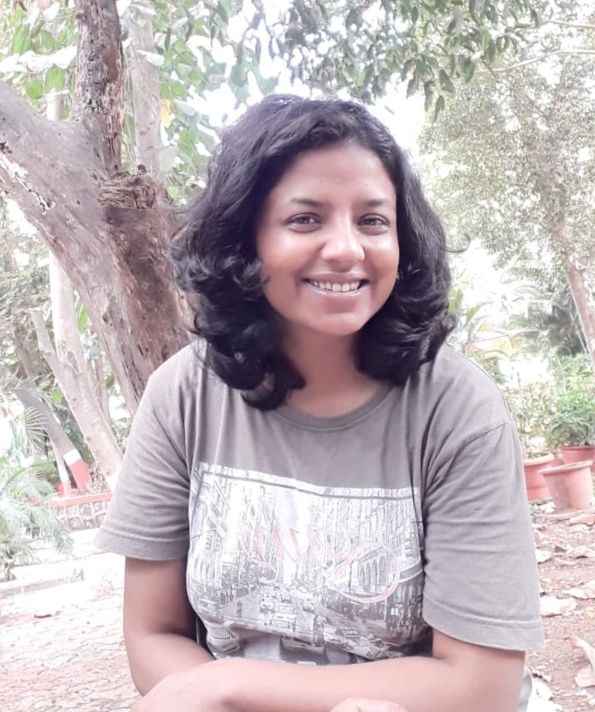
Yasmin Soni is a doctoral scholar at TISS and is passionate about gender justice and parity.