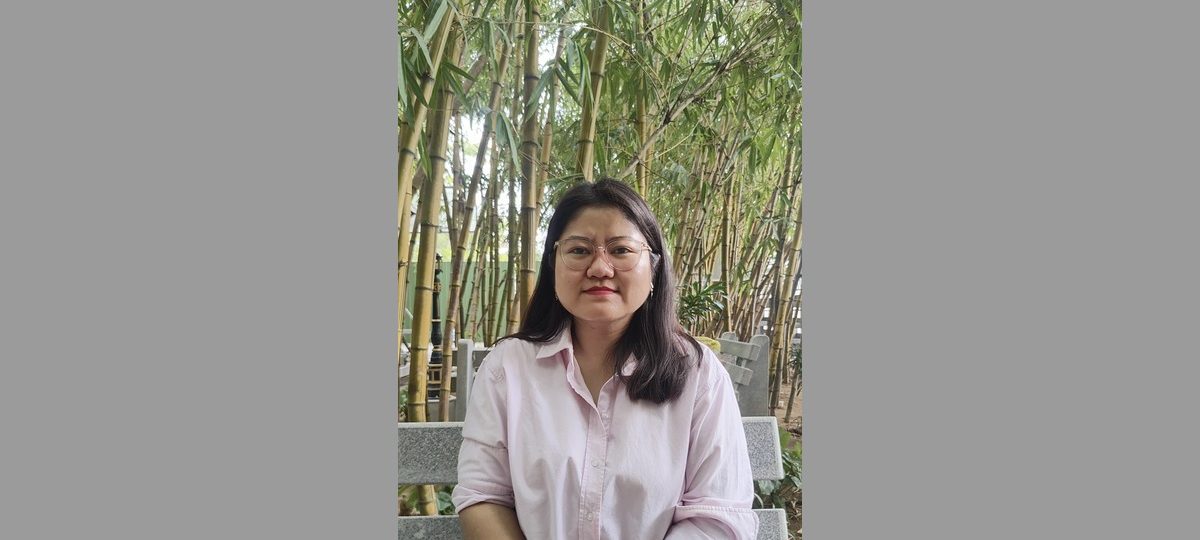
Duhaisami Tochhawng
You scroll through a reel of Aizawl at dusk. The camera pans across the ridge. Terraced houses cling to the slope, holding on the way our houses do because our land is nearly vertical and there is nowhere else for them to sit. The light is soft. The audio is Japanese, likely a scrap of dialogue pulled from a series or a film and laid over the frame. It is not translating anything; it has no connection to what you are looking at. It is there because it sounds like somewhere else, and that is what aesthetic means now.
I have been thinking about that reel for weeks and about the comments under it. Most of them are from Mizos. Most are proud – feels like Kyoto, little Japan of India, hard to believe this is India. And I have been trying to name precisely what is wrong with the fact that we are the ones cheering.
A recent essay on this platform traced how counterculture and marginalized aesthetics only become palatable once dominant groups appropriate, sanitize or rebrand them. That essay was writing about punk, about Gandhi’s ascetic performance, about the Mary Kom yellowface. I want to extend the argument in a direction the writer only gestures toward – what happens when the aesthetic being consumed is not a jacket or a film but a land, a festival, a woman in puan (traditional Mizo wrap) at Chapchar Kut and the consumers arrive by the trainload.
The friend who stopped being interesting
A friend told me a story recently. She was at her hostel in a mainland university, and a non-Northeast girl came up to her, bright and curious, and asked where she was from. Meghalaya, my friend said. The girl became warm, generous, full of questions. They chatted for a while. Then at dinner, in a group, someone mentioned in passing that Meghalaya is a state in India, the girl went quiet. She stopped speaking to my friend. Over the course of the evening she drifted away, and by the next day she had forgotten my friend existed.
I keep returning to that story because it captures the machinery so cleanly. My friend was interesting when she was foreign. She became invisible the moment she was recategorized as Indian. Nothing about her had changed. What changed was the girl’s calculation of what my friend was worth to her – as an exotic acquaintance, potentially high; as a fellow citizen from a place she considered peripheral, nothing. That transaction is what governs how mainland India encounters the Northeast now and it is what governs the shape of the tourism arriving in Mizoram.
Little Switzerland, Little Japan, Little Anywhere-But-Here
The comparisons come constantly. Little Switzerland. Little Japan. Just like Korea. The whole vocabulary is diminutive. Not Switzerland. Little Switzerland. The mainland viewer is not permitted to see Mizoram as itself. They can only see it as a pocket substitute for somewhere they would rather be, somewhere they cannot afford to fly to. The land is granted value only through comparison and only as a smaller, cheaper, more accessible version of an actual destination.
What this does is protect the viewer from having to revise their mental map. Mizoram is allowed to be beautiful only if that beauty is imported. The moment the beauty is claimed as Indian and Mizo, on its own terms, the frame collapses. That is why you see the second move so often – the pivot to “see, this is India too, not a foreign land.” When someone points out that Aizawl does not honk, that Mizos queue, that the streets are clean, the same voice that a moment ago called it Little Switzerland now insists that this is India, this is us. Both moves are doing the same work. Both are refusing to let Mizoram be Indian and orderly at the same time, because that would force a reckoning with why the places the viewer considers the real India are neither.
The railway reaching Aizawl has been described in the national press as a milestone of connectivity. It is. It is also a distribution system for this gaze at scale. When I first heard the trains were coming, my thought was not about goods or jobs. It was about the tourists. How were we going to handle them, not in the logistical sense. In the sense of what they would do when they arrived believing they had earned access to a curiosity and what we would feel obliged to give them.
The women at Chapchar Kut
At festivals across the Northeast now, videos are circulating of men, tourists from the mainland, grabbing women in traditional attire to pose for photographs. Sometimes the woman is pulled by the arm. Sometimes she is not asked at all. The entitlement is complete: I am here, I am making a reel, be grateful. She is not a person attending her own festival; she is set dressing. It is not only the women. Men in traditional attire are grabbed too, and every Mizo body at these festivals is being treated as available for someone else’s phone. What is particular about what happens to the women is the older, familiar layer of sexual entitlement laid on top of the tourist entitlement. The tourist’s hand on a stranger’s arm is familiar in a longer history.
This is not a Mizo problem alone. It is what indigenous people around the world have described for over a century. There were tribal museums once. There were human exhibitions at world fairs. There is a long, ugly genealogy in which people considered picturesque are made available for the gaze and touch of those who consider themselves the audience. The reel is the modern successor to the postcard, and the postcard was the modern successor to the ethnographic photograph, and the photograph was the modern successor to the display case. Each iteration insists the encounter is friendlier than the last. Each iteration continues to treat the indigenous body as material.
The food conversation runs on the same logic. A blog went around recently in which a mainland tourist asked the Mizoram government to arrange for vegetarian food to be made available. A friend of mine said, “Will Madam ask the government of Sweden or Thailand to provide vegetarian food?” She would not. Because Sweden and Thailand are understood to have their own legitimate culture, their own food, their own hosts. The demand made of Mizoram assumes something else: that we are internal enough to be reformed to mainland preference and exotic enough to be photographed while we cook. The tourist wants both at once. The Instagram-foreignness and the dal.
What troubled me most were the Mizo comments under that blog. Apologetic. Yes. We should try. Yes, we should be more accommodating. Yes, we are hospitable. And I want to say, hospitality is not the same as self-erasure. Tlawmngaihna (a Mizo ethic of selfless service to others; altruism) is never meant to be a suicide pact. It is meant to hold a community together; it was not meant to teach us to apologize for feeding our guests what we cook.
This is not new, and it is not only ours
The essay I am building on named the machinery through Fanon – the colonized subject learning to see themselves through the colonizer’s gaze. That framing matters here because it lets us refuse the idea that any of this is unique to our moment or our people. Indigenous nations in the Americas have written about it. Ainu people in Japan have written about it. Sami people have written about it. Adivasi communities across central India have written about it, though the mainland reader is far less likely to have encountered their writing. The specific texture is ours. The pattern is old.
Edward Said described how the Orient was constructed by European writers as an object of curiosity, an aesthetic backdrop, a place whose people existed to be observed and interpreted rather than heard. The mainland gaze on the Northeast does the same work at a smaller scale. We are the internal Orient of the Indian imagination. The reel that gives us a Japanese soundtrack, the tourist who cannot believe this is India, the university that programmes us as culture, all inherit a logic Said named nearly half a century ago.
Bourdieu argued that dominant groups police aesthetics as a way of maintaining hierarchy and that inclusion of the marginalized in dominant spaces almost always requires that we be sanitized first. What tourism does is invert the geography of this dynamic. It brings the dominant group into the marginalized space and demands the sanitization happen at home, in front of us, using our own labour. We are asked to keep the parts of ourselves that photograph well and quietly discard the parts that do not. The performance of Mizoness for the tourist is a curated Mizoness, edited by their expectations, staged with their comfort in mind.
The rot from within
I want to be careful here because it would be easy to make this a piece only about outsiders. It is partly that. But if I am honest, the harder part of the argument is that many of us are participating.
The audio in that reel was not chosen by a Japanese tourist. It was chosen by a Mizo creator. The blogs and travel writing that describe our land through borrowed comparisons was written by Mizos. The apologetic comments under the vegetarian food blog were written by Mizos. Even the name of our capital has been travelling misspelled through books, government documents, blogs and travel writing for years. “Aizwal” instead of Aizawl. Most of us have stopped noticing. There is a way we have learned to describe our own home that treats a foreign frame as more valuable than our own and a foreign audience as more worth pleasing than our own community.
It goes further than describing. A video went viral recently of the Cheraw restaged for aesthetic effect. The steps had been altered, the tempo shifted, the choreography rearranged to sit better with whatever the algorithm was rewarding that week. The ecosystem that rewards this kind of restaging is not one we built for ourselves, and it is worth asking what it is doing to what we consider ours. Traditions live only if they change; that is not the objection. The objection is that this particular change is being made not for us but for a viewer whose attention is the whole point of the exercise.
I speak from inside this. I am from Mizoram. I love my land in the specific, aching way you love a home you know intimately. I also have many problems with it. I am not writing from a position of pastoral affection. I am writing because I want the best for a place that is mine, and I do not think the best for it is to be turned into a photogenic backdrop for someone else’s holiday content.
Very few people from outside are going to help us think through any of this. Look at what universities across mainland India are doing with us. Indigenous Day, Ethnic Day, a cultural week, an alumni programme – the calendar never runs out. And every time, some of the country’s best-known institutions host what they call cultural fests. What this means, invariably, is that Northeast students are asked to sing, dance, cook and dress. That is the sum of the engagement. We appear in the mainland imagination as dancing mascots, and the university is where that imagination gets rehearsal space. There are no reading lists. There are no papers. There are no scholars from our communities invited to speak on their own work. There is a stage, and there are our bodies on it, and the institution calls this celebration. It is the tribal museum with a hashtag.
The conferences are often worse because they mistake themselves for serious. I have sat in rooms at well-regarded institutions while a conference/talk/seminar/panel about tribal studies proceeded on the assumption that all tribal peoples of India could be treated as one undifferentiated subject. Nobody on the panel could distinguish between the political conditions of a Mizo, a Naga, a Bodo, an Adivasi in Jharkhand, and a Gond in Chhattisgarh. Everyone spoke with confidence anyway. The Northeast students in the audience were quiet, and I understood their silence. When you are one of the few from your community in an institution, you do not speak up in front of an educator who marks your dissertation. The cost of correcting the room is borne entirely by you. The cost of the room being wrong is borne by no one. This is not a failure of our students. It is a failure of the people paid to know better, who have decided our communities are a theme to be programmed, not a body of thought to be studied.
We can save ourselves
The missionary logic in our history taught us, among other things, that we were fortunate to be saved. What was said to be saving was often the same machinery that indigenous peoples elsewhere have named for what it was – a rearrangement of who got to speak, who got to be respected, what was allowed to survive and what was pathologized. I say this as someone whose community is largely Christian and whose faith is part of who we are. The point is not to relitigate the church. The point is to notice that the shape of the saviour narrative is still with us, only now the saviour arrives with a DSLR and asks where the good angle is.
The well-meaning outside liberal is not going to save us. The travel industry that describes us in someone else’s language is not going to save us. The Bollywood director who casts a mainland actress in yellowface to play our sister is not going to save us. Our senior colleagues in mainland universities, who could open a door with a signature and often will not, are not going to save us.
There is a name for what I am asking. It is the ethics of portrayal, and every indigenous scholarly tradition worth reading has spent decades working out its principles. The people being portrayed have the right to consent to the portrayal. They have the right to withdraw that consent. They have the right to be described in their own language and on their own terms. They have the right to correct portrayals that fail these tests. An ethics of tourism runs alongside it and says the same things in a different register – the visitor does not inherit ownership of a place by arriving in it, the photograph is not authorized by proximity and the demand for accommodation is not the same as the offer of hospitality. Consent is not implied by presence. Portrayal is not authorized by attention. Hospitality is not an obligation to be photographed.
We can save ourselves. It requires very little that is dramatic. It requires us to stop apologizing for feeding our guests what we cook. It requires us to stop describing our home in borrowed tongues. It requires us to push back, insistently and unfashionably, for what our communities are actually rich in, not just song and dance for the visitor to film, but workshops, conferences, publications, curricula, archives. If mainland audiences want to know us, let them come to a lecture, not just a festival. Let them buy a book, not just a reel. Let them fund a research chair, not just a homestay.
And when someone at Chapchar Kut reaches for a woman’s arm to pull her into a photograph, we do not need to be polite about it. Tlawmngaihna does not require us to be handled. Our land does not need to be compared to a foreign one for it to be good enough. It already is. It always was.
~~~
Duhaisami Tochhawng is a doctoral researcher in law at Christ University, Bengaluru.