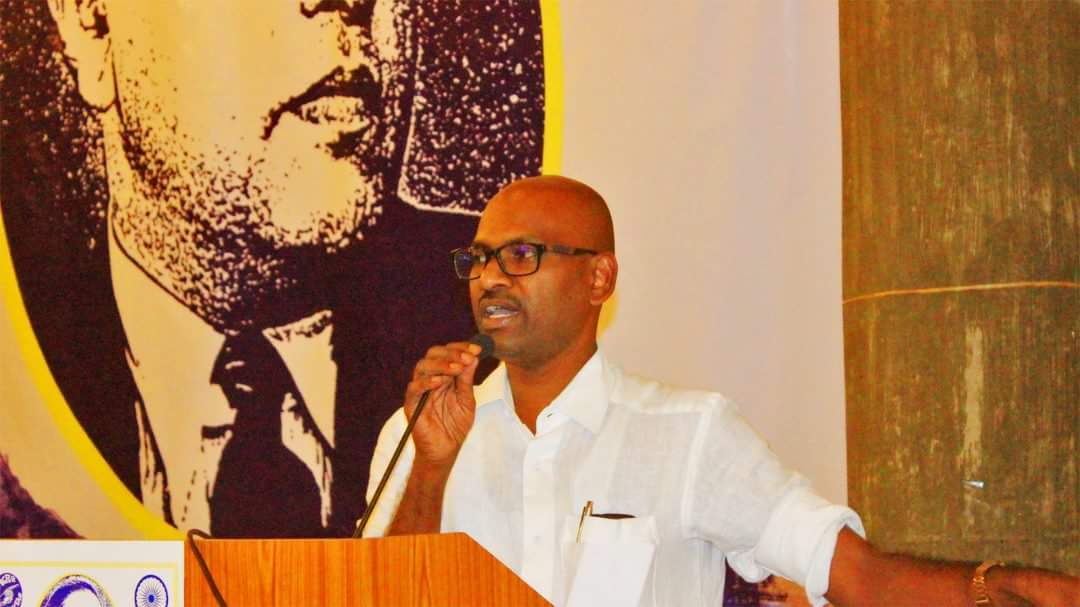
Dr. B. Karthik Navayan
In Telangana, the term “civil society” evokes images of principled activism: women’s groups marching for justice, human rights organisations amplifying marginalised voices, and political parties channelling public anger into demands for accountability. Yet this activism reveals a troubling selectivity when the victim belongs to a Scheduled Caste (SC) community, especially a vulnerable migrant labourer. The stark contrast between the high-profile handling of the Miss X POCSO case and the alleged gang-rape and murder of Late Rekha Waghmare exposes what can only be described as caste-driven hypocrisy. Telangana’s so-called civil society functions less as a beacon of universal justice and more as a caste society indifferent, even complicit, when atrocities target SC “untouchable” communities.
The Miss X Case: Swift Action, Political Storm, and Current Legal Position
In May 2026, Bandi Sai Bhageerath, son of Union Minister of State for Home Affairs Bandi Sanjay Kumar, faced serious criminal allegations under the Protection of Children from Sexual Offences (POCSO) Act and relevant sections of the Bharatiya Nyaya Sanhita (BNS). The complaint, lodged on May 8, 2026, by the mother of Miss X, a 17-year-old girl, accused him of repeated sexual harassment, assault, emotional manipulation, and coercive acts over several months at various locations, including a farmhouse in Moinabad.
Despite his father’s prominent political standing, the initial state machinery moved with noticeable readiness. Following an intense police manhunt and the issuance of a lookout notice, Telangana police arrested Bhageerath on May 16, 2026. He was remanded to judicial custody, subjected to custodial police interrogation, and the investigation proceeded swiftly amidst massive public scrutiny. Protests erupted across Hyderabad and throughout the state; women’s groups, student organisations, and opposition parties (including BRS, CPI, and others) staged aggressive dharnas and demonstrations demanding accountability and an impartial Special Investigation Team (SIT) probe. The media covered every twist and turn relentlessly, ensuring that political patronage could not quietly bury the case.
Regarding the latest position in the case, after spending over 50 days in judicial detention, Bandi Sai Bhageerath approached the Telangana High Court seeking regular bail. On July 9, 2026, Justice K. Sujana of the Telangana High Court granted him regular bail subject to strict conditions. Following his release on bail, Bhageerath moved the High Court seeking orders to restrain social media platforms and mainstream media outlets from publishing defamatory content or reporting prejudicial material concerning the POCSO case, in which the High Court subsequently passed interim restraining directions and sought counter-affidavits from the respondents. While the prosecution’s trial process and chargesheet proceedings continue under the statutory oversight of the special POCSO court, the case stands out as a prime instance where public mobilisation, political contention, and intense civil society pressure forced law enforcement to register the FIR promptly, arrest a powerful minister’s son, and hold custodial interrogation.
The Late Rekha Waghmare Case: Systemic Silence, Cover-Up, and Institutional Apathy.
At roughly the same time, an appalling horror unfolded in Donkeshwar village, Nandipet Mandal, Nizamabad district. Late Rekha Waghmare, a 32-year-old Scheduled Caste woman and migrant agricultural labourer hailing from Patoda Khurd village in Dharmabad Taluka, Nanded district, Maharashtra, was found dead under highly suspicious circumstances on the afternoon of February 13, 2026.
Since 2021, Rekha and her husband, Devidas Waghmare, along with their two young daughters (Jeevika, aged 10, and Sona, aged 8), had been living in a small shed on the agricultural land of a local influential landlord, Barla Narsing Reddy, working on a salaried labour basis. According to the consistent representations submitted by Rekha’s brother-in-law, Sri S. Sanjeev, the landlord had repeatedly harassed Rekha and attempted to exploit her. On February 13, 2026, Narsing Reddy intentionally sent Devidas away to work at another distant agricultural plot with strict orders not to return until all work was finished. The children were away at school. Taking advantage of Rekha being completely alone, Barla Narsing Reddy and his associate, Vittal Empalwad (or Emphalwar), allegedly broke into the house, overpowered her, and brutally gang-raped her. When she resisted and attempted to flee, they allegedly murdered her, arranged her body to pretend a hanging, and staged a suicide. They then summoned Devidas, broke down the door in his presence, took photographs, and concocted a story that she had died by suicide.
Instead of initiating a rigorous homicide and sexual assault investigation, the local Nandipet police acted in overt collusion with influential village figures. As detailed in formal representations, police constables Shabir and Vijay, acting alongside a local influential individual named Bharat Reddy, hurried the deceased woman’s body away to the hospital before a formal inquest or inspection by the Sub-Inspector could be conducted. Taking gross advantage of the fact that the grieving family members were non-native Marathi speakers unfamiliar with the Telugu script, the Nandipet police drafted a manipulated Telugu complaint and obtained signatures from Rekha’s 70-year-old father, Meesaye Gangadhar Maadhu. Consequently, Nandipet Police registered FIR No. 33/2026 only under Section 108 of the Bharatiya Nyaya Sanhita (BNS) for abetment of suicide—shockingly naming Rekha’s own husband, Devidas Waghmare, as the sole accused, while completely shielding the real perpetrators, Barla Narsing Reddy and Vittal Empalwad.
Glaring Forensic Evidence Contradicting the Suicide Theory
The official post-mortem examination (PME No. 103/2026 dated 14.02.2026, conducted at Government Medical College / Government General Hospital, Nizamabad) revealed damning physical findings that directly destroy the suicide narrative:
- Severe Antemortem Head Injury: A massive 8 x 4 cm contusion was recorded over the left parietotemporal region of her scalp, accompanied by underlying subdural haemorrhage over the left frontotemporal region of the brain. This severe blunt-force trauma to the head is completely incompatible with an ordinary hanging and remains entirely unexplained by the police suicide theory.
- Absence of Vital Reaction in Ligature Mark: The neck examination noted a pressure abrasion (25 x 2-3 cm) obliquely situated above the thyroid cartilage. Dissection revealed that the subcutaneous tissue under the ligature mark was whitened, hardened, and glistening without extravasation of blood in and around, while the hyoid bone and thyroid cartilage remained intact. The absence of vital bleeding reactions strongly indicates that the ligature was applied when the victim was in an entirely non-responsive, incapacitated state, ranging from deep unconsciousness to complete biological death—a classic medical hallmark of homicidal violence staged as hanging
- Defensive Injuries: The autopsy documented distinct abrasions measuring 2 x 1 cm on the back of the left arm and 3 x 2 cm on the back of the right elbow, pointing to defensive struggle against violent physical assault. Subsequent Regional Forensic Science Laboratory (RFSL) Kamareddy reports confirmed that no poisonous substance was found in the viscera (File No: RFSL/KMR/TOX/104/2026, dated 17.03.2026). While seminal stains were not detected on vaginal/anal swabs (File No: RFSL/KMR/SER/11/2026, dated 02.03.2026), the presence of massive blunt intracranial trauma and defensive abrasions undeniably established homicidal foul play.
The Institutional Wall: Closure by SPCA and Continued Harassment of the Bereaved Family
Faced with deliberate police sabotage, the victim’s family, assisted by an advocate pursued remedies across every institutional channel. Formal representations demanding reinvestigation, addition of gang-rape and murder charges under BNS (Sections 64, 70/66, 103) and the SC/ST (Prevention of Atrocities) Act, 1989, and the constitution of a Special Investigation Team (SIT) or transfer to CID, were submitted to the Commissioner of Police, Nizamabad (complaints dated 24.02.2026 and 02.03.2026), the District Collector & Magistrate, Nizamabad, the Director General of Police (DGP), Telangana, the State Public Prosecutor at the Telangana High Court (representation dated 06.04.2026), and the National Human Rights Commission (NHRC, New Delhi, complaint dated 22.03.2026).
Far from ensuring an independent investigation, the local police doubled down on intimidation. On April 23, 2026, the victim’s grieving husband, Devidas, was unlawfully detained at the Nandipet Police Station for hours solely to coerce him into signing statements forgiving the landlord. The Investigating Officer categorically refused to record his supplementary statement under Section 161 CrPC.
A formal complaint was also placed before the Telangana State Police Complaints Authority (SPCA), Hyderabad. Initially, the SPCA had issued notices and reminder memos directing the Commissioner of Police, Nizamabad, to conduct an inquiry and submit a comprehensive report. However, on September 1, 2026, the Chairman of the State Police Complaints Authority, Justice Dr. B. Siva Sankara Rao (Retired High Court Judge), issued final proceedings (Proceedings C.No. 116/S1/SPCA/2026). Accepting at face value the enquiry report submitted by the Commissioner of Police, Nizamabad (Letter C.No. G1/267-271-329/CPO-NZB/(SPCA)/2026 dated 31.08.2026), the Authority summarily closed the matter.
The SPCA order stated that the enquiry report clearly disclosed suicide by the deceased, dismissed the family’s suspicions of gang-rape and murder as being “with no basis,” and ruled that there was no basis to take cognizance against any police personnel. By rubber-stamping the self-exonerating report of the very police commissionerate accused of shielding upper-caste suspects, the statutory complaint mechanism effectively shut its doors on the family, sanctifying the police cover-up under legal finality.
Compounding this injustice, the bereaved family of Late Rekha Waghmare is still left wandering from pillar to post, roaming around police stations and administrative offices just to obtain a copy of the enquiry report that was allegedly submitted to the Police Complaints Authority. In a blatant display of institutional non-transparency and high-handedness, neither the State Police Complaints Authority nor the district police authorities have furnished a copy of this vital enquiry report to the family. The victim’s husband and relatives are forced to knock on official doors repeatedly, only to be turned away, denied access to the very document that was used behind closed doors to dismiss their plea and whitewash the grave allegations of sexual violence and murder.
The Hypocrisy Laid Bare: Caste Society Masquerading as Civil Society
The simultaneous timelines of these two cases lay bare the systemic fault lines of Telangana’s public sphere. In the Miss X case, an allegation involving influential families provoked an immediate, coordinated reaction: high-decibel street protests, relentless television debates, dharnas outside police directorates, and interventions by mainstream women’s organisations. That sustained public outcry gave the police no room to compromise, forcing an arrest and custodial interrogation within days.
In stark and shameful contrast, the alleged gang-rape and murder of Late Rekha Waghmare, a destitute Dalit migrant mother whose body carried an 8 x 4 cm scalp contusion and subdural brain hemorrhage, was met with complete, deafening silence. On April 3, 2026, an online petition was initiated and circulated across social media platforms, WhatsApp groups, Facebook, and X (formerly Twitter). Yet not a single mainstream political party held a dharna. Not a single prominent feminist forum marched through the streets of Hyderabad or Nizamabad. The civil society organisations that claim to stand for democratic rights stayed comfortably silent.
Even more disheartening is that Ambedkarite and Dalit organizations also failed to take up this grave issue for reasons known only to them. Because Rekha Waghmare was merely an impoverished, landless migrant laborer, her brutal death offered neither immediate political mileage nor high-profile visibility. It was neither a prominent electoral issue nor a fight over the promotion or bureaucratic posting of an influential Scheduled Caste officer, matters that often galvanize Dalit and employee associations into vociferous agitations and press conferences. Her utter lack of socio-economic capital and political utility rendered her invisible even to those claiming to safeguard Dalit rights, proving that institutional apathy is compounded by internal indifference when the victim is a powerless, working-class woman from the margins.
Why this disparity? The answer lies in the harsh reality of social power. When a victim belongs to an influential or socially dominant stratum, society identifies with her victimhood, and outrage becomes a currency of civic duty and political advantage. But when the victim is a Dalit woman, an “untouchable” migrant labourer from another state whose alleged killers are local landed elites, the calculations collapse into indifference. The police feel no pressure from civil society, the administration faces no electoral threat, and oversight institutions like the Police Complaints Authority effortlessly dismiss grave forensic trauma based on one-sided, concealed police memos.
Conclusion: A Call for Reckoning and Justice
A genuine civil society cannot operate on selective empathy. When human rights defenders, feminists, and political platforms extend their solidarity only to privileged victims while abandoning Dalit women to systemic state violence and police collusion, they cease to function as a civil society; they function as an entrenched caste society.
The Telangana Police Complaints Authority’s summary closure of the complaint on September 1, 2026, and its refusal to even provide the family with the inquiry report, is not the end of this struggle; it indicts an entire system. Justice for Late Rekha Waghmare requires immediate judicial intervention, an independent Special Investigation Team probe uncompromised by local influence, the alteration of FIR No. 33/2026 to include murder and gang-rape charges under the BNS and the SC/ST (Prevention of Atrocities) Act, and stringent accountability for the police officers who fabricated statements, suppressed forensic evidence, and concealed inquiry records. As long as the people and leaders of Telangana ignore the crimes committed against poor and powerless communities, their boast of being a modern, fair, and progressive society is just a fake front.
~~~
Dr. B. Karthik Navayan, Advocate and Human Rights Activist