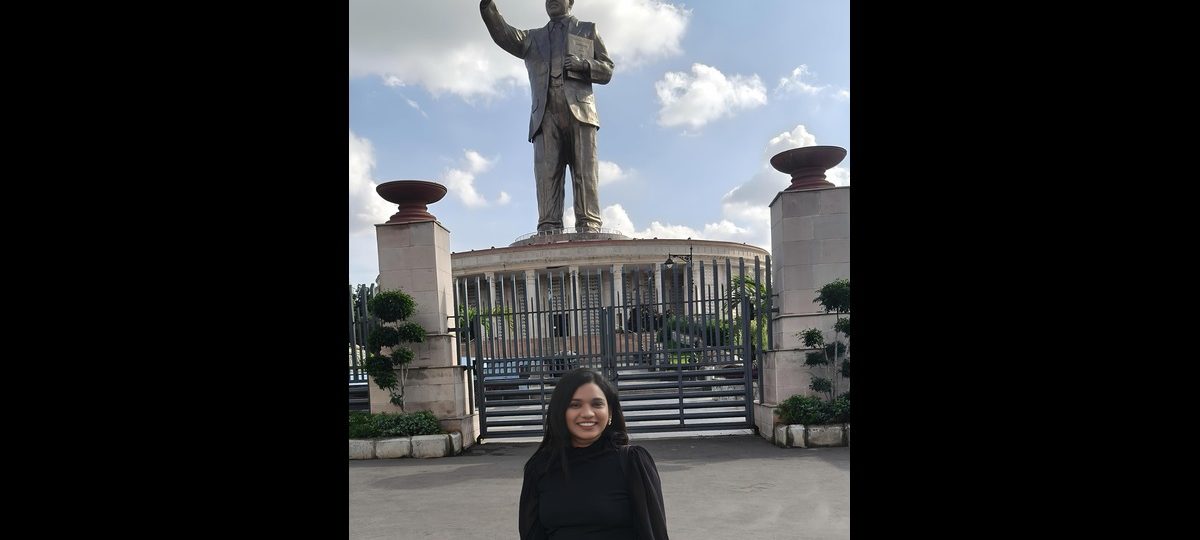
Anusha Racheti
“Political democracy cannot last unless there lies at the base of it social democracy.” – B. R. Ambedkar, Speech to the Constituent Assembly, 25 November 1949.
This warning by Ambedkar reminds us that democracy is not just about institutions or elections, but about whether people can truly speak and be heard. In many villages, democratic spaces exist on paper, yet deep social hierarchies continue to decide whose voice matters and whose silence is taken for agreement. During my fieldwork in Visakhapatnam district on public service delivery and citizen participation in local governance, I visited several villages to understand how services reach people under the newly introduced Village Secretariat system in Andhra Pradesh. While filling out questionnaires and interacting with villagers, I often sat near the Gram Panchayat office, where groups of elderly men gathered to discuss local politics and welfare matters. I introduced myself as a researcher, and our conversations slowly moved beyond schemes and entitlements to deeper questions of power in everyday village life. Many people told me that welfare schemes now reach their doorsteps, unlike earlier times when they had to travel to the Mandal office, spend money on transport, and sometimes pay bribes to get their work done. This change, they said, reduced costs and saved time. Women, especially, spoke of relief at not having to leave agricultural work or household responsibilities to stand in long queues. On the surface, this appeared to be a success story of improved governance, something often celebrated in policy reports as proof of decentralization and efficient service delivery.
However, when I asked about their experience of participating in village decision-making, particularly in the Grama Sabha (the core institution of grassroots democracy), the tone of the conversation changed. People became hesitant. Most of those I spoke to were Dalits and daily wage labourers. They told me they rarely entered the Panchayat office unless called by a dominant-caste elder. When they attended Grama Sabha meetings, they usually sat quietly, simply to mark their presence. Their participation, they said, was more about “being there” than “having a say.” At that moment, I began to realise that for many Dalits, participation often feels like an illusion dressed in the language of inclusion. Their presence is recorded, their names are counted, but their ability to shape decisions, raise questions, or make demands is rarely taken seriously. Participation becomes a performance while the real power remains in the hands of dominant caste actors. Scholars have long argued that mere presence in public forums does not ensure voice or influence, especially for socially marginalised groups.
One of the most revealing conversations was with a Dalit woman in her early twenties. When I asked her about the Grama Panchayat and Grama Sabha, she said that she had no idea what happened in those meetings. She had been married at a young age, dropped out of school, and had never entered the Panchayat office. Her husband or in-laws handled all the matters related to welfare or village issues. Her words reflected a deeper reality where Dalit women’s exclusion is not only political but deeply rooted in household structures, economic dependence, and gendered expectations. For many Dalit women, participation means being represented by male relatives who may or may not express their needs accurately. Even when Dalit women, like women from other castes, are elected as representatives, their authority is often limited. Many are expected to simply sign documents while real decisions are taken by male family members. This phenomenon, sometimes described as “proxy representation,” has been widely observed in studies of Panchayati Raj institutions (Pai, 2001). Dalit voices are rarely silenced through open refusal. Instead, they are filtered and controlled through everyday practices often shaped by caste and local power. Being invited to Gram Sabha meetings or holding reserved seats does not guarantee freedom to speak. When Dalits raise concerns about sanitation, housing, or access to resources, their demands are sometimes labelled as “too sensitive” or “too demanding.” Meanwhile, safer and less controversial topics are prioritised. In such settings, only certain kinds of Dalit voices are welcomed: specifically, those that are polite, grateful, and non-threatening to dominant caste interests.
Outside formal meetings, silence is maintained through subtle signals like glances, gestures, nervous laughter, and social pressure. Many Dalit respondents told me they attend Gram Sabha meetings mainly to assist with arrangements. They sit quietly, avoid eye contact with dominant caste men, and hesitate to speak for fear of social backlash. In some villages, Dalits are seated at the back or near the door, while dominant caste members occupy the front rows. Such spatial arrangements silently communicate who belongs at the centre and who remains at the margins. Even Dalit representatives who are formally elected often find themselves negotiating carefully with dominant caste elites. Their survival in the village depends on maintaining working relationships with these groups. As a result, they may compromise on community demands or avoid raising contentious issues. Dalit women, facing both caste and gender barriers, are even more likely to remain silent, with their voices mediated through male relatives.
On paper, the 73rd Constitutional Amendment guarantees representation for Scheduled Castes, Scheduled Tribes, and women in Panchayati Raj Institutions. Reserved seats were meant to ensure that historically excluded communities gain a meaningful role in local decision-making. However, as scholars like Niraja Gopal Jayal (2009) have pointed out, formal representation does not automatically translate into substantive power. Social hierarchies continue to shape how meetings are conducted and whose voices are taken seriously. If participation is measured only through attendance records or the number of schemes delivered, we risk mistaking presence for power. The everyday discrimination that silences Dalit voices remains invisible in official reports. What matters is not only whether people are present, but whether their concerns are heard, respected, and acted upon. Studies on decentralisation in India have repeatedly shown that caste power continues to influence local governance despite institutional reforms (Mosse, 2006).
These everyday conversations during fieldwork helped me understand that “present but not heard” is not just a phrase but a lived reality for many Dalits in village governance. Their presence in meetings does not automatically lead to influence over agendas, decisions, or resource allocation. Silence is often produced not by direct refusal but by subtle cues: a dismissive glance from a dominant caste elder, a quiet interruption, or the pressure of social dependence. In this way, participation becomes a ritual rather than a pathway to power.
As a public policy researcher, these encounters forced me to rethink what participation really means. Instead of asking only who attends meetings, perhaps we must ask whose voices shape decisions. Instead of counting bodies, we must listen to speech. And instead of treating caste discrimination as a background issue, we must recognise it as the very structure that shapes who speaks, who is heard, and whose silence is wrongly interpreted as agreement. Only when participation moves beyond presence to real voice can local democracy become meaningful for Dalit communities.
References
-
Agarwal, B. (2023). Gender, presence and representation: Can presence alone make for effective representation? Social Change, 53(1), 34-50.
-
Ambedkar, B. R. (1949). Speech to the Constituent Assembly, 25 November 1949. In Dr Babasaheb Ambedkar: Writings and Speeches, Vol. 13. Government of Maharashtra.
-
Jayal, N. G. (2009). The limits of representative democracy. South Asia: Journal of South Asian Studies, 32(3), 326-337.
-
Mosse, D. (2006). Collective action, common property, and social capital in South India: An anthropological commentary. Economic Development and Cultural Change, 54(3), 695-724.
-
Pai, S. (2001). Social capital, panchayats and grass roots democracy: Politics of dalit assertion in Uttar Pradesh. Economic and Political Weekly, 645-654.
~~~