Madhuri Kamtam
I have been meaning to write about this journey for a long time. I always imagined it would be an essay. But when I signed up for the Bosla Arts and Studio 12 Open Mic Solidarity Night in London in June 2026, poetry felt like the only honest form.
The spirit of that evening – the refusal of silence, the insistence on being heard – reminded me of something I had recited every morning as a child in a hostel in Telangana: I am not inferior to anyone—one of the ten commandments of SWAEROES.
So I went. And I performed this poem. I wrote about an earlier part of this journey in a 2023 essay for the Round Table India. This poem begins where that essay ends.
A Chair I Never Dreamed I’d Sit On
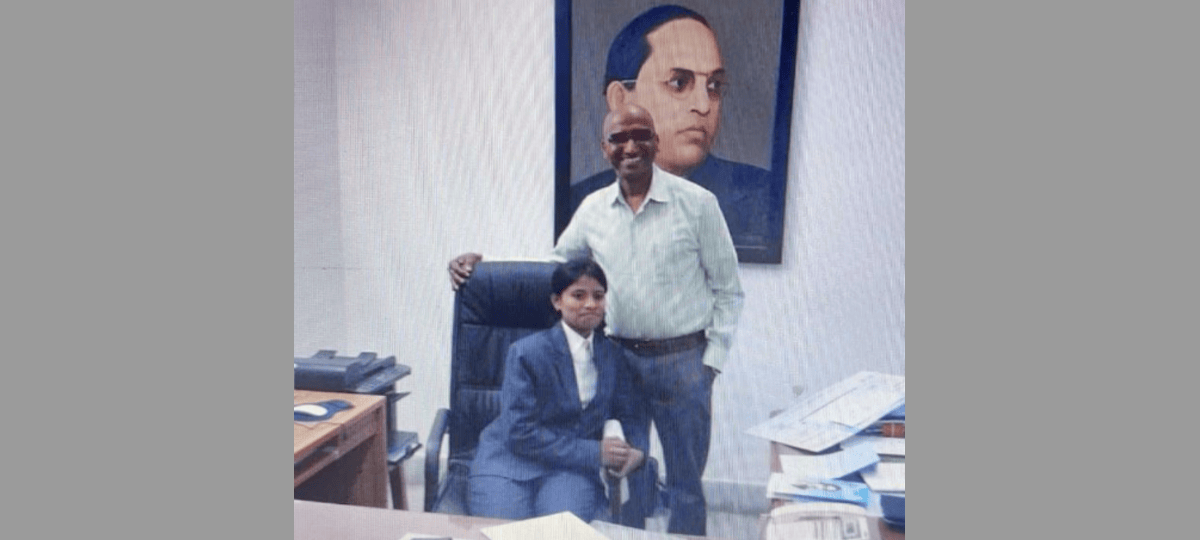
This photograph was taken when I was 17 years old, after my live-telecast television class that was broadcast on MANA TV to students across 268 Social Welfare Residential Schools in Telangana.
The lesson was part of the S. R. Shankaran Super Students programme, one of the many visionary initiatives introduced by Dr R. S. Praveen Kumar. Built around the motto Earn While You Learn, the programme encouraged students to develop their teaching and public speaking skills by delivering live television lessons to fellow students. Those selected to teach also received an honorarium in recognition of their work.
After each live session, the student-teacher would visit Dr. Praveen Kumar’s office, where he would personally congratulate them and present the cash award. In this photograph, he invited me to sit in his chair – a gesture of encouragement and belief that meant far more to me than I could fully understand at the time.
The cash award rests on the desk in front of us. Behind us hangs a portrait of Dr B. R. Ambedkar. It is a photograph I have always held especially close to my heart. Like so many memories from my years in the Social Welfare Residential Schools, this photograph reminds me of the opportunities we were given to dream beyond our circumstances.
Back then, we did not have smartphones or easy ways to take and preserve photographs. Years later, someone who had kept this picture found a way to reach me through mutual friends and shared it with me. I am deeply grateful they did, because they preserved more than a photograph. They preserved a moment that represents not just an achievement, but an entire chapter of my life – one that continues to shape and inspire me today.
The Poem
I am here.
I am here.
Am I?
Really here?
Born the youngest of three daughters
in a small town in rural Telangana,
I was the one who always wanted to study, study, study,
The one who said yes
Before the question had even found its end.
There was a small school in the village.
We went when we were little, my sisters and I.
But fees have a way of growing.
when parents’ wages do not.
My father heard about the social welfare schools.
Free. Residential. For children like us.
My sisters had already gone.
And I?
I topped the entrance exam.
I was ten years old.
I packed my bags.
Not because I had to leave.
Because I was ready.
I walked into that hostel.
not running from home
but running toward something,
toward making it all mean something,
toward making them proud,
craving the independence
I had watched my sisters earn.
I was not scared.
Not at all.
My sisters,
who were always there,
through everything difficult and dark,
through every personal storm,
who endured so much
so that I would not have to.
They protected me
with a love that asked nothing in return.
Because of their sacrifices,
I could dream bigger.
I could go further.
I carry them with me.
Everywhere I go.
Every single morning
We stood in that assembly.
And we recited:
I am not inferior to anyone.
I shall be a leader wherever I am.
I shall always think big and aim high.
I shall never give up.
I believed every word.
I still do.
When Dr. R.S. Praveen Kumar sir
became our secretary,
Everything changed.
Elocution. Debate competitions.
Summer camps. Voice4Girls.
Super Students, earn while you learn.
Coaching for law, coaching for accountancy,
whatever door you wanted to walk through,
He made sure paths were laid.
Between the ages of ten and seventeen,
We were being made.
Confidence built in small rooms
where nobody had expected to find it.
I shall always think big and aim high.
I shall never give up.
At 17, when we were leaving those schools,
He had already made sure.
We had roads leading in every direction.
Law. Accountancy. Sciences. Arts.
Whichever door we wanted to open,
There was coaching, preparation, and a way in.
I said yes to everything.
Because when opportunity
rarely knocks at your door,
You do not make it wait or come back later.
You open the door.
You run through it.
You figure out the rest on the other side.
An exam.
Then an interview.
Two people sat across from me.
And saw something
I could not yet see in myself.
A scholarship.
A university in Bangalore.
Economics. Another state. A new city.
For someone who had never left home,
Bangalore felt like the whole world.
I thought, ‘This is it.’
This is the furthest I will go.
And I was so, so grateful.
I shall always think big and aim high.
I shall never give up.
At 18, in that same university,
I stepped outside.
Into the so-called real world.
And the real world
introduced me to myself
in a way no classroom ever had.
I did not know I was Dalit.
until the world outside
decided to tell me.
In our social welfare schools, we were all the same.
all from somewhere deprived,
all from families the system had pushed to the edge,
Caste was not the wall between us.
We had enough walls already.
But here the air was different.
In the way people looked at you,
in the way they did not,
in the space they gave you
and the space they did not.
I learned what I was.
through the way I was treated.
Dr B. R. Ambedkar had already named it.
My grandparents had lived it.
My parents had carried it.
My whole community had endured it.
Generations before me,
Not I alone.
It shattered something in me.
That same university also gave me the tools.
to think about it, to sit with it,
to understand it not just as pain
but as something built,
something that had been unfolding
long before I was born.
And then it equipped me.
The faculty there
became mentors for life.
People who believe in you
before you have the language
to believe in yourself
To change the direction of everything.
They are still there, guiding every path.
I finished the degree.
I applied for everything again.
I would do anything.
as long as I was not doing nothing.
And then I heard it, almost in passing:
People apply abroad.
I thought: not people like me.
No way. Not a chance.
I shall never fear the unknown.
I applied anyway.
I got into SOAS, London.
MSc Development Economics.
But funding was everything.
And I had none.
I was shortlisted for a scholarship.
Interview in Delhi.
A city I had never been to.
I had a Dabba phone.
and no money for the flight.
Dr R.S. Praveen Kumar,
the man who gave us the word SWAERO,
who told us every morning
that the sky had no limit,
paid for my ticket.
When a girl with a Dabba phone
had no money to get to her own future,
He simply made sure she could.
A kind senior helped me navigate Delhi –
every street I did not know,
every turn in a city that was not mine.
Some doors cannot be opened alone.
She opened one for me.
I gave the interview.
A month later
I am on an overnight bus to Bangalore,
staying at a friend’s place
because I know nobody there,
on my way to yet another interview
because I said yes to everything, remember?
I wake up at 6 am,
still on the bus,
half asleep,
and there is an email.
I read it once.
I read it again.
Felix Scholarship.
SOAS.
London.
I call my parents.
The first thing they ask is,
‘Did you reach safely? Are you okay?’
And I say,
“Yes”,
and then I say,
“I got the scholarship.
I am going to London.”
My mother kisses me through the phone.
‘Bangaru thalli,’ she says.
My golden daughter.
My father’s voice, steady and warm:
We knew you could do it.
You always do.
You are our daughter.
That is it.
That is all of it.
SOAS,
London.
It is happening.
A passport.
It had never even crossed my mind
that I would ever need one.
I got one.
Before I left,
My mother held my face and said,
ae janmala yesina punyamo,
What good deeds did we do?
in a past life
that our daughter gets to go abroad?
My mother,
whose hands have rolled beedis
for as long as I can remember,
bent over bundles of tobacco leaves
since before I was born,
for wages that do not add up to dignity,
hands that worked in the heat
so that mine could hold a pen,
She held my face
and called it a blessing from a past life.
A girl.
From our background.
Going abroad.
She said it like a prayer.
I carry it like one.
I went abroad at 20, almost 21.
I did not believe it.
until I walked out of Heathrow.
I took a black cab, I know, I know.
My first time in another country,
I did not know any better.
I got to Paul Robeson House.
Started unpacking.
And then it hit me.
Oh god. I am here.
I am really here.
I actually did it.
Oh god. Why did I come here?
Ha.
That is what doing it scared feels like.
Feeling all of it.
Sitting with all of it.
And doing it anyway.
A kind senior
helped me find my feet in that foreign city,
showed me how to be
in a place that did not yet know me.
I will never forget the kindness I received.
In a country that was not mine.
I shall never fear the unknown.
I shall never give up.
I am on the streets of London.
staring up at the skyscrapers,
and someone laughs:
“You’re from Hyderabad,
You must have seen this before.”
I said:
I am not from Hyderabad.
I am from Jagityal.
I am from Telangana.
And there is a whole world there.
beyond what you picture.
Not every Brown person speaks Hindi.
Not every person who makes it abroad
comes from a city.
And not every Telugu person
has the accent you expect.
I will speak in my pakka Telangana yaasa
and I will not apologise for it.
And yes,
I will keep staring.
Not to enjoy the reek of capitalism
but to take it all in,
to hold it in my chest and say:
You are here.
You are actually here.
I studied.
COVID hit.
I navigated.
I finished my masters.
Two mentors – professors who had taught me
back in Bangalore,
mentors for life –
saw something in me I could not yet see.
They encouraged me to apply for a PhD.
That is what mentors do.
They show you paths
you did not know existed.
And so I went home.
Now here is what they do not tell you
about a girl in her twenties
from a small town in Telangana:
there are other plans
already being made for you.
Marriage is not a question –
It is a calendar.
A girl your age, they say.
A good family, they say.
Why does she need to go so far, they say.
My parents were different.
They always were.
Neither of my parents ever went to school.
Not a single day.
I was among the first in my entire family
to ever walk through a school gate,
alongside my sisters,
And none of us had a map.
But they always said:
“Whatever you want.
Whatever you need.
We never got the chance.
You will.”
But it is never simple.
It is never just one conversation.
When you come from a culture
where a daughter’s happiness
is measured in different ways,
where the path is already laid out
before you even pick up the pen –
Every negotiation carries weight.
A PhD was different.
Three more years. Another country.
That took a different kind of asking.
I sat with my parents and I said:
Three years.
One of those years I will be in India.
Doing fieldwork, I will be home.
What I did not say,
but what they understood,
was that I was not coming back
in the way they had hoped.
They said yes anyway.
Because they are my parents.
Because they never got a chance.
Because they love me
in a way
That is bigger than the plan.
I shall always think big and aim high.
I shall never give up.
At 22 I came back to the UK.
For a PhD.
I studied labour laws.
and the women who roll beedis
in homes just like mine –
women like my mother –
bent over leaves and tobacco
in the informal economy,
invisible to policy,
essential to industry.
I wrote about their work.
Because someone had to.
Because the same hands rolled me too.
Rolled me into what I am today
Because research is also a way of saying:
I see you.
I have always seen you.
You made me.
The PhD was impostor syndrome at 2 am,
knowing too much and not knowing enough,
being a young Dalit woman far from home,
carrying my mother’s hands of love and pride imprinted in my chest,
carrying everything,
while trying to make it count.
At 26 I finished it.
It was hard.
Very hard.
I did it anyway.
I shall always think big and aim high.
I shall never give up.
Now I am 27.
Two job offers.
In two big cities in the UK.
Fifteen-plus publications –
Twenty-plus international conferences –
One Best Paper Award.
Not that any of this is the measure of a life.
Academia will tell you it is.
We should have a light laugh at that.
Loudly.
And then question it.
Because let me tell you
what none of it captures.
We performed in spaces to “fit in” and then “stand out”
Ha! The irony!
We navigated everything by ourselves –
as young people, as women, as Dalits,
as humans, just trying to live,
trying to understand what living meant
when the world kept telling you
you were not supposed to be here.
But we had joy too.
Real joy.
The most beautiful kind.
We experienced everything.
The stories we tell.
The ones we hide in our poems.
The ones we have the courage to say aloud.
The ones that will find their way into the world one day.
The ones we carry to our graves.
Some will make it into the world.
Some will not.
We tell our own stories.
We tell them in our own way.
That is everything.
I am everything.
Not just this.
Not just that.
I am everything.
And so are you.
Because when I count what matters,
I count my people.
I think about the girls I grew up with.
in those schools.
The ones now married, raising beautiful children,
working so hard, doing it all.
The ones in offices, building something.
The ones whose dreams got redirected
before they could choose.
The ones in marriages they did not choose,
who cannot get out,
who are fighting every single day.
The ones doing extraordinary things
with the least.
All of them.
I remember every one of them.
I see you.
I know what you are going through.
I know,
because I carry it too.
Not I alone.
My parents. My sisters.
My grandparents. My great-grandparents.
Our whole community.
The suffering is not mine alone.
Neither is the joy.
It will pass.
And you will shine.
Because that is what we do.
We dream big. We aim high.
And we bring each other with us.
Taking up space matters.
Speaking up matters.
But so does passing the mic.
To the one whose story
has not been told yet.
To the one whose voice
has been pushed further down than yours.
To the one still fighting to be heard.
To the one who could not make it out.
To the one still dreaming of making it.
This poem is for all of you.
I shall always think big and aim high.
I shall never give up.
And I am writing this letter.
to the little girl I was
and to every little girl and boy
still in those schools,
still in those hostels,
still staring at the ceiling
wondering whether the sky
they keep being promised
is really meant for them.
It is.
It is.
I am your proof.
We broke it.
We beat it.
We did it.
I am not inferior to anyone.
I shall be a leader wherever I am.
I shall always think big and aim high.
I shall never give up.
Just like that,
Madhuri Kamtam
became
Dr. Madhuri Kamtam.
What a decade can do: I dedicate this poem to my maternal grandmother, Chinnamayi, whom I never had the chance to meet. She passed away due to illness and a lack of proper healthcare when my mother was still a little girl. Her absence became a loss that echoed across generations.
Life is often unfair. Our mothers endure so much, carrying grief, sacrifice, and resilience with them. Whether or not they had the love, presence, and support of their own mothers, they continue to nurture, protect, and love us with extraordinary strength.
This poem is dedicated to all mothers and grandmothers, whose love, resilience, and sacrifices shape generations, and especially to the countless Dalit women whose strength and survival continue to inspire those who come after them.
Annotations
Dalit: Communities historically placed at the very bottom of India’s caste hierarchy, subjected for centuries to exclusion and discrimination. Dr B.R. Ambedkar devoted his life to the annihilation of caste and to securing dignity and justice for these communities. His legacy runs through every line of this poem.
TSWREIS (Telangana Social Welfare Residential Educational Institutions Society): A network of state-funded residential schools in Telangana, created for children from historically marginalised communities. Education, boarding, and lodging are provided free of cost. Throughout the poem, I refer to them simply as the hostel or the social welfare schools.
SWAEROES: A term coined by Dr R.S. Praveen Kumar for students of TSWREIS. SW stands for Social Welfare; aero evokes the sky. The sky is the limit. Dream big. Aim high. No reverse gear. No turning back. Every morning, we recited the Ten Commandments at assembly. Several of them appear throughout this poem at the moments they were needed most.
Beedi: A hand-rolled cigarette made by wrapping tobacco in a tendu leaf. Beedi rolling is informal, home-based labour performed largely by women from historically marginalised communities for extremely low piece-rate wages. My mother is a beedi worker.
“A Decade Later” is a poem reflecting on the last ten years of my life. It looks back on the journey from age 17, when I left TSWREIS, to age 27. In that decade, everything changed – through education, opportunity, hardship, and growth. This poem is my attempt to understand how those ten years shaped the person I have become.
~~~
Madhuri Kamtam is a postdoctoral researcher whose work focuses on labour welfare, caste, gender, and the political economy of development in India. Her PhD, completed at the University of East Anglia, UK, examined the impact of labour laws on home-based beedi workers in Telangana. She is a proud Swaero.