Manoj Bag
In August 1931, during his first formal meeting with Mohandas Karamchand Gandhi at Mani Bhavan in Bombay, Dr. B.R. Ambedkar made a declaration that fundamentally shattered the nationalist illusion of a unified anti-colonial front: “Gandhiji, I have no homeland.” To grasp the profound weight of this statement, one must first interrogate what it truly means to call a place a “homeland.” A homeland is not merely a geographic expanse bounded by political borders, nor is it defined simply by possessing a passport or a constitutional territory. A homeland is a space of radical belonging—a site where an individual can exist freely, with uncompromised dignity and fundamental liberty. In his autobiography, Nelson Mandela captured this primal essence of freedom when he wrote: “I was not born with a hunger to be free. I was born free—free in every way that I could know. Free to run in the fields near my mother’s hut, free to swim in the clear stream that ran through my village, free to roast mealies under the stars and ride the broad backs of slow-moving bulls.” For Mandela, as for any human being, a true homeland is a place where freedom is the natural baseline of existence.
At a time when anti-colonial dissent was at its peak, Ambedkar’s blunt denial of the undisputed leader of the independence struggle was an act of extreme political honesty. It laid bare his genuine sense of alienation on behalf of his people. How could a man claim a homeland in a nation that systematically denied his basic human dignity? For the Untouchables, the daily tyranny of caste Hindu society—expressed through forced segregation, denial of public water, physical violence, and systemic humiliation—was far more immediate, brutal, and historically entrenched than British colonial rule. Ambedkar recognized that while Gandhi fought against British colonialism, the upper-caste leadership was eager to preserve its internal feudal empire. To declare to Gandhi that a country built on social injustice is a prison for its most oppressed people, not a homeland, was an act of profound refusal.
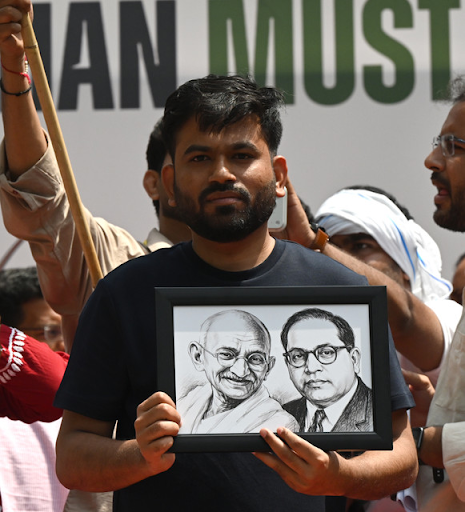
Today, as youth-led demonstrations at Delhi’s Jantar Mantar—organized by the Cockroach Janta Party (CJP) over widespread NEET paper leaks and national examination irregularities—draw thousands of marchers, CJP founder Abhijeet Dipke and his companions carry “a photo of Dr. Bhim Rao Ambedkar, M.K. Gandhi, and a copy of the Indian Constitution” to ensure their protests remain peaceful. As mainstream civil society, student unions, and GenZ youth movements routinely frame Gandhi and Ambedkar side-by-side as twin patrons of democratic dissent, an urgent Ambedkarite critique demands to be posed: Has post-colonial India posthumously constructed a “home” for Ambedkar by diluting his radical anti-caste framework into a sanitized, state-sanctioned icon, paired with the very ideology he spent his life dismantling?
It is widely assumed today that Ambedkar eventually found his “home” in the post-colonial Indian Republic. The dominant narrative holds that the drafting of the Constitution, the formal abolition of untouchability under Article 17, and his elevation to national icon status granted him and his people the homeland he was denied in 1931. However, we must critically interrogate the difference between the “home” Ambedkar spoke of then and the “home” offered to his people now. The homeland Ambedkar envisioned was not merely a territorial entity with a flag and a legal code. It was a true social democracy anchored in pratitya-samutpada (interconnectedness), liberty, equality, and fraternity. It was a home where the annihilation of caste restored moral community, dignity, and real political agency to the depressed classes. What the post-colonial Indian state offers instead is a structural illusion: a constitutional home on paper, accompanied by an unchanged Brahminical social order in practice. The state eagerly claims Ambedkar as the “Father of the Constitution” to validate its democratic credentials globally, yet actively strips his memory of its radical, anti-caste methodology.
To claim that Ambedkar or Dalits have found a home in modern India is to ignore their daily lived reality deliberately. Are Dalits no longer facing discrimination? The empirical reality tells a devastating story. The “home” constructed by the modern nation-state remains a site of ongoing, systemic violence for Dalits. Untouchability has not vanished; it has merely adapted to modernity. When a Dalit student is beaten to death for touching a water pot, or when a village is terrorized because a Dalit woman is appointed as a cook in an Anganwadi centre, the state reveals its true character. It is the same hostile environment Ambedkar confronted in 1931. The atrocities may have acquired a modern legal vocabulary, but the underlying alienation remains fundamentally unchanged. The modern state offers a house with legal rights, but denies the social equality required to make it a home.
When contemporary movements like the CJP youth protests at Jantar Mantar adorn their stages with parallel portraits of Gandhi and Ambedkar, they operate under the naive assumption that both icons represent complementary facets of “Indian democracy.” This optical convergence creates a profound political contradiction. Gandhi’s framework relied on appealing to the oppressor’s moral conscience through self-suffering, moral guilt, and normative harmony within the Hindu fold. Ambedkar’s framework explicitly rejected moral appeals to the upper-caste conscience. Having experienced the intransigence of caste Hindus, Ambedkar demanded structural power, legal guarantees, institutional representation, and relentless social organizing—Educate, Agitate, Organize. By placing Ambedkar alongside Gandhi without addressing his harsh criticism in What Congress and Gandhi Have Done to the Untouchables, movements like the CJP reduce intense historical struggle to a gentle, liberal consensus. They create a fictitious impression of intellectual solidarity between two essentially incompatible political ideologies. The CJP protests, despite their anger against state incompetence, relied almost entirely on classical Gandhian tactics—hunger strikes (such as Sonam Wangchuk’s fast), moral appeals, and calls for non-violent self-restraint—while brandishing Ambedkar’s photograph as an aesthetic badge. This reduces Ambedkar from a radical strategist of structural emancipation to a passive symbol of generic, law-abiding dissent.
In contemporary protest culture, carrying Ambedkar’s portrait has increasingly become a substitute for practicing Ambedkarite politics. Liberal movements use Babasaheb’s image to shield themselves from accusations of elitism or political bias, deploying his icon as a moral badge without committing to anti-caste struggle. This optical inclusion is an insidious form of exclusion. When a movement uses Ambedkar’s face to demand educational reforms or anti-corruption laws but remains completely silent on reservation policies, caste-based violence, or institutional murder within the very same education system, it privatizes Ambedkar’s image. It takes Babasaheb out of his political context—the battle against Brahminical supremacy—and turns him into a generic liberal mascot. This commodification creates a false sense that Ambedkar has been integrated into the mainstream nation, when in reality, his radical thought is being sanitized so that it no longer threatens upper-caste hegemony.
Ambedkar remains posthumously homeless because the nation-state and broader civil society invoke his constitutional authority while systematically preserving the caste structures and Gandhian moralisms he dedicated his life to dismantling. A photo of Ambedkar placed next to Gandhi at Jantar Mantar does not represent the reconciliation of two great minds; it represents the forced, posthumous co-optation of an anti-caste revolutionary into a nationalist pantheon he sought to transform radically. Ambedkarite politics cannot be satisfied with carrying his portrait as an aesthetic accessory to Gandhian protest tactics. It demands the uncompromised application of his strategy: dismantling Brahminical hegemony and realizing a true social democracy where no citizen is ever forced to declare, “I have no homeland.”
~~~
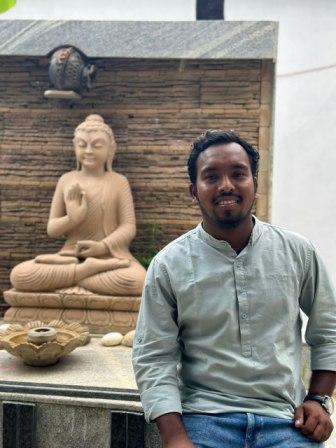
Manoj Bag is an independent researcher from Odisha. He has completed his M.A from EFLU Hyderabad.