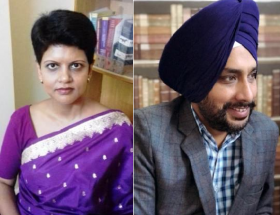

Prof. Vivek Kumar
Gen-Z, as a homogeneous category, is not possible in India because Indian youth are not a uniform social group. First of all, historically, because of Varnashrama-Dharma, there was no category of youth in Indian society. Because after Brahmacharya, individuals directly entered into the Grahastha Ashrama. Hence, there was no time to enjoy their youth.
Therefore, it was only after the advent of the British, who opened universities, that the category of youth began to emerge. It was when college-going youth, after gaining their graduation degrees, started looking for employment or for admission into higher degrees that the category of youth crystallized in Indian society.
Indian youth can be broadly divided into six categories:
Rural youth – Even today, about 68 percent of India’s population lives in rural areas. Rural youth remain deeply embedded in the networks of family, kinship, village life, and religious values.
Urban youth – Those living in towns and cities have experiences distinct from their rural counterparts. They are usually the offspring of first-generation migrants to cities. As they are usually first-generation migrants from rural areas, they are tied to their traditional values, burdened by the aspirations of their parents, and they keep on preparing for IITs, MBBS, or IAS exams.
Metropolitan/Westernized youth – These are young people who comfortably dress in Western styles, listen to Western music, watch Western films, and increasingly seek admission to foreign universities or elite private institutions.
Globalized youth – In the age of globalization, they aspire to work in places such as Silicon Valley. They are compelled to acquire not just one but multiple degrees and continuously pursue new diplomas or online courses to remain competitive.
Dalit, Adivasi, and minority youth – Their sense of dignity and self-respect is often wounded by the continuing experiences of discrimination, injustice, and social exclusion faced by their communities.
Politically affiliated youth – These are young people active in the student organizations of various political parties. They are often unwilling to move forward independently of their political leaders.
There is yet another category of youth that has just finished watching the IPL. Others are engrossed in television shows such as Indian Idol, India’s Got Talent, and Nach Baliye.
In such a situation, each group of youth has its own concerns and priorities. There is no unified agenda that binds all Indian youth together. The divisions of caste, class, religion, and region make collective unity difficult. Even when such unity is achieved, it is often the youth who ultimately feel deceived or betrayed.
Recall what happened to the youth who participated in the Indian freedom struggle. Which social groups benefited from the JP Movement? Which castes and regions were most actively involved in the implementation of the Mandal Commission recommendations? Who were the driving forces behind the movement led by Kisan Baburao Hazare (he is not Anna for me), and which caste and class groups ultimately benefited from it?
These questions suggest that the experiences, aspirations, and outcomes of youth mobilization in India have never been uniform, making the idea of a single, cohesive Indian Gen-Z highly problematic.
~~~
Prof. Vivek Kumar is a Professor of Sociology, Centre for the Study of Social Systems/ School of Social Sciences, JNU