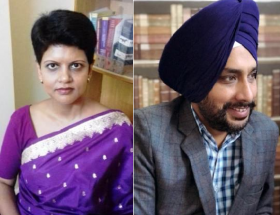

Dr Neeraj Bunkar, Mahesh Admankar
The Movement’s Origins — and What We Didn’t Know
The Cockroach Janta Party emerged as a satirical response to a controversial remark attributed to Chief Justice of India Surya Kant Sharma, who, during a court hearing on May 15, 2026, compared unemployed youth involved in social media, journalism, or RTI activism to “cockroaches” and “parasites”. Dipke posted on X announcing a “new platform for all the cockroaches,” adding a Google form for whoever wanted to be a part of the new party, describing eligibility as being “unemployed, lazy, chronically online and ability to rant, professional”.
What is critical to acknowledge here is that the overwhelming initial enthusiasm was largely caste-blind — not in a progressive sense, but in an inadvertent one. Millions rallied behind the slogan, the satire, and the voice without knowing who was behind it. The caste identity of the founder was simply not part of the picture, and that absence is itself revealing.
The Caste Reveal and Its Brutal Aftermath
A user had directly asked Dipke whether CJP would take a stand on reservation and Dalit issues. An hour later, Dipke responded, “I am a Dalit myself. I hope that will answer all your questions”. What followed was swift and ugly. Reactions ranged from users claiming he had “played the D card” to others labelling him as being “against merit”. Several users posted derogatory comments, while others accused him of political opportunism or questioned his ideological position.
This is worth sitting with, not rushing past. The same audience that celebrated “bold, anti-establishment” commentary within days turned the comments section into a caste tribunal. It was not just trolling by fringe actors — it was a visible, widespread pattern. The lesson here is not simply about Dipke. It is about how a caste-neutral framing of dissent is often — consciously or not — coded as ‘upper caste’ by default. The moment that assumption was disrupted, sections of the fanbase revealed what they had actually been celebrating.
The Platform Itself Is Not Neutral — A Necessary Caution
There is a tendency in commentary like the original essay to romanticise social media as a democratising force for marginalised voices. This deserves pushback. Platforms like X operate through algorithmic amplification that rewards engagement, not equity. What goes viral is shaped by who constitutes the dominant user base, whose sensibilities drive the engagement loop, and which frames resonate with the most active demographic.
The CJP phenomenon trended primarily within a certain slice of digitally fluent, English-comfortable, urban Indian youth. The virality itself should not be mistaken for genuine inclusivity. When platforms amplify a Dalit voice, they often do so despite the caste of the person, not because platforms have overcome caste logic. And as the backlash showed, once caste is made explicit, the same platform architecture is readily weaponised to suppress, humiliate, and discredit.
The Bahujan Community’s Skepticism — Don’t Dismiss It Too Quickly
This is perhaps the most important corrective. From the very beginning, many voices from the Bahujan and Dalit community were skeptical — labelling CJP as an “elite Gen-Z movement,” a meme dressed up as politics, or worse, an ‘upper caste’-coded anti-establishment pose that conveniently avoided naming caste as its central target.
Reservation policy quickly became one of the biggest flashpoints in the CJP manifesto’s comment sections, with numerous users demanding “merit-based” selection and “no caste-based reservation”. That this happened within CJP’s own community space — and seemingly without adequate pushback from the movement’s core — is not a small thing. It raises a legitimate question: if the “cockroach” framing is truly about the dispossessed and the structurally excluded, where does it stand on the policy mechanisms that exist specifically to address structural exclusion?
The Bahujan skepticism is not reflexive cynicism — it is grounded in a long history of being invited into movements that eventually reproduce caste hierarchy once the novelty fades. Dismissing that skepticism as “cancellation culture” would itself be a form of elite Gen-Z privilege. At the same time, writing off the movement entirely on day one also forecloses the possibility of holding it accountable, pushing it to evolve, and seeing whether it develops an actual structural politics. A “wait and watch” posture is genuinely more useful here than either uncritical celebration or immediate dismissal.
The Ideological Ambiguity Is a Problem, Not a Feature
The original document’s framing enthusiastically maps CJP onto Ambedkarite principles. That framing should be approached carefully. Ambedkarism is a rigorous, specific intellectual and political tradition — it is not simply “anti-establishment energy” or “frustration with inequality”. It demands a clear ideological commitment to the annihilation of caste as a structural project.
Political figures like Shashi Tharoor, Mohua Moitra, Kirti Azad, and lawyer Prashant Bhushan have posted in support of CJP — figures from across the conventional left-liberal spectrum. That breadth of endorsement is precisely where one should pause. A movement that is all things to all people often ends up being accountable to none of them. When the same digital space simultaneously hosts “end caste-based reservation” comments and Ambedkarite solidarity posts under one hashtag, the ideological incoherence is not a minor footnote — it is the central unresolved tension.
CJP’s self-description reads: “Secular, socialist, democratic, lazy”. Satire can be a starting point. But as a political positioning, it defers every hard question. Whether the movement can move from irony to actual ideological clarity — particularly on caste — remains genuinely open.
Conclusion: Hold the Conclusions
The honest assessment here is one of watchful uncertainty. The backlash against Dipke’s Dalit identity reveal is real and damning — it confirms what Dr. Ambedkar spent his life arguing. But the movement that surrounds him is not yet Ambedkarite simply because its founder is Dalit, nor is it doomed simply because its early fanbase included people who later revealed their casteism. Social movements are contradictory, messy, and often find their actual character only under pressure over time.
The Bahujan community’s early caution deserves respect and sustained attention. The platforms amplifying CJP deserve scrutiny, not celebration. And the ideological direction of the movement — especially regarding caste, reservation, and social justice — remains a live question that neither the founder nor his followers have yet resolved. That is where the real story is. We are better off watching it unfold honestly than narrating a conclusion that the facts haven’t yet earned.
~~~
Dr. Neeraj Bunkar is a researcher specializing in caste and cinema.
Mahesh Admankar is a PhD researcher at the University of Massachusetts Boston whose work focuses on caste, political economy, and questions of social justice in South Asia and the United States.