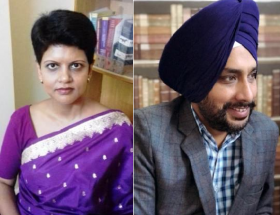
Umar Nizar
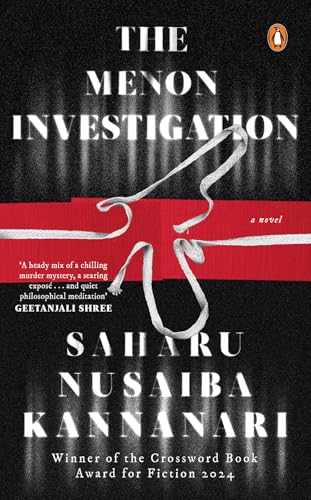
The Menon Investigation’ by the prize-winning novelist Saharu Nusaiba Kannanari is an absolute cracker of a thriller that, in its socio-political ramifications, is, to use a well-worth cliché, unputdownable. The titular Menon’s interiority and anxieties about his dark skin colour in a racist society form an unlikely backdrop to this work of fiction. The liminal status of the hero, Vijay Menon, who is an Inspector General of Police in Kerala and who reopens the case about the murder of a policeman, Kannan Moses, and the ensuing thrills form the crux of the story. The author himself has been noted for his debut novel, `Chronicle of an Hour and a Half’, which won the `Atta-Galatta’ and the `Crossword’ awards for fiction, not a mean feat by any standards. But in his second novel, the author has chosen to walk on the left side of cool. The policeman hero is not only not valorised, but he is also at the receiving end of much veiled criticism, and ensuing moral ambiguity adds layers to the novel, often missing in Indian English crime fiction. There is a hilarious moment when the hero comes across a social media post by his spouse, a medic:
“Then came a small post on Malayali’s skin colour obsession, and then a short story she had written, about a blind man who refuses to marry a dark girl, which was basically an argument between the marriage broker and the angry client, and he stepped down from the bowl. He had to. This was her most popular post so far, garnering more than 200 comments and 800 likes and almost 1000shares, and he put aside the phone and washed his ass thoughtfully, wondering why she had picked up the topic at all, she who had never written a story before, not in his knowledge, and whether this particular story would have garnered so many likes if she wasn’t as fair as she was and her husband a Dark Menon?” -Saharu Nusaiba Kannanari, The Menon Investigation
The titular hero, Vijay Menon, is dark in colour, a fact that haunts him, and the fact that his genes are passed on to his progeny is not making things easier for him in this fictional world. The haemorrhoids that he suffers from not only make the hero the antithesis of the dashing policeman, but also function as an index of the risible embodiment of caste locations in the 21st century. The novel has multiple layers, and the anxieties of its hero are only surface deep. There is a staggering, detailed treatment of a planned contract killing in Calicut in Kerala, a terrain that the author is apparently familiar with. This cinematic layer is juxtaposed with arboreal interludes where the long durée of political insurgency is evoked. This is nothing short of a tectonic shift in Indian crime fiction. The multiple layers come together marvellously, and it won’t be a misplaced comparison to put the novel alongside some of the best in the world.
Kerala has, of late, become a colourist one. Glutathione tablets and injections are all the rage. `Healing Clinics’ (read whitening booths) dot the urban landscape and have even made their inroads into suburbia. The craze for skin whitening cuts across gender barriers and has gone beyond cosmetology and well into dermatology. This fascination with white skin can no longer be considered skin deep.
The attention paid even to `genital fairness’ with pharmaceutical and cosmetic firms coming out with creams for private parts, such as `Clean and Fair’, which evoked protests from women’s organizations, the neoliberal capitalist establishment has totalised its control over the bio-political imaginary. The taboo with dark skin is not a visual one, as the erogenous zones of the human body, thus targeted, are not visually prominent in the normal human social interactions. The connotations that link the genitals to acts of procreation and to supposed racial purity should also not be forgotten. Within the body, various body parts follow a hidden inner hierarchy of skin colour, according to which the genitals and those parts of the anatomy that appear darker are lower in the hierarchy. There also exists a hierarchy of orifices whereby those orifices occurring above the waist are considered `pure’ and those occurring below are deemed `impure’, as studied by anthropologist James Aho. -Umar Nizarudeen, RoundtableIndia
The fascination with ‘whiteness’ in cinema and lens-based media has much to do with the contemporary colourist state of things. In the past, it was not unusual for a Keralite to have names such as `Karuppan’ or `Karuthamma’ (meaning `the black one’). The Scandinavian designers and developers of camera lenses have ensured that their products are tested on melanin-less northern types, and the beauty and texture of tropical bodies are lost on them. The `whiteness’ that reflects light right back at you zaps the nervous system and induces a temporary high, and hence is valued for its intoxicating effects. This novel is an antidote to senses `drunk on whiteness’.
Saharu Nusaiba Kannanari, the author of the work, has used a sardonic tone and counter-intuitive attitude in his first novel, `Chronicle of an Hour and a Half’, as well, which had Muslims in Malabar lynching one of their own over an amorous escapade. This combination of scathing social critique, fluent and flawless prose, and eminent readability forms a rare combination in `The Menon Investigation’ as well. Kunnanari has excelled himself in this latest iteration. The hero, a Menon by caste, is compared to a hapax legomenon, owing to his dark skin. This is a novel that will send the reader not just to the dictionary but also the quiz book and encyclopaedia, multiple times.
The Blackkklansman from Kerala, raising the tricolour on Capitol Hill, is reminiscent of Otto Weininger in obnoxious tracts such as ‘Geschlecht und Character’, who over-identified with the Nazi regime and composed tirades of anti-Semitism and misogyny while being a victim himself and finally committing suicide. No less alarming was the heroic reception that the Malayali ‘Klansman’ was given by local vernacular language news channels, which gave prime time space to an avuncular terrorist. Though not paraded in public, this would go a long way as perhaps one of the greatest self-goals scored in the service of right-wing extremism in Kerala. -Umar Nizarudeen, Milli Gazette
References
2. https://www.milligazette.com/news/Opinions/33816-blackkklansman-on-capitol-hill-v4kerala-and-the-rise-of-the-malayali-macron/