
Shilpa
Dasra and Navratri are widely celebrated across India as a festival of devotion, divine femininity, and the victory of Goddess Durga over the demon king Mahishasura. However, beneath this widely accepted narrative lies a complex history that reveals layers of caste, culture, and identity politics. A growing movement among Dalit, Bahujan, and Adivasi communities questions this traditional version. It seeks to reclaim Mahishasura not as a demon, but as a martyred leader of a marginalized {Dalit}community.
Revisiting the Legend of Mahishasura
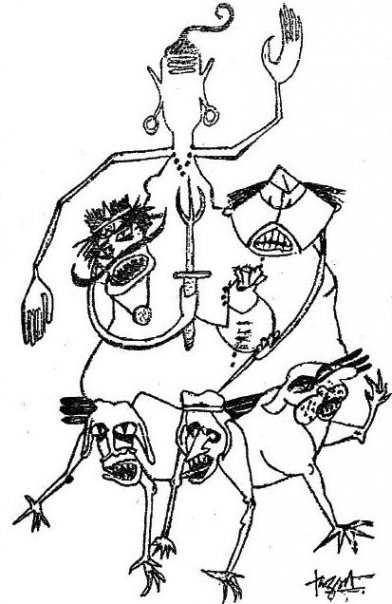
Mahishasura is often portrayed in Hindu mythology as a buffalo-headed demon who terrorized the three worlds—earth, heaven, and the netherworld. Legend says that he was granted near-immortality by Lord Brahma, with one condition: he could only be killed by a woman. Confident in his invincibility, Mahishasura launched an assault on the gods. In response, the trinity of Brahma, Vishnu, and Shiva combined their energies to create Goddess Durga, who ultimately defeated and killed him after a fifteen-day battle.
In Brahmanical scriptures, this event is celebrated as the triumph of good over evil, symbolized through the worship of Durga’s nine forms during Navratri. But for many non-dominant communities, this story isn’t just mythology—it’s a narrative tool used to disparage their ancestral heritage.
Mahishasura: A Symbol of Dalit Resistance
Alternate traditions, rooted in oral history and regional memory, depict Mahishasura not as a demon, but as a powerful and just king—possibly a Dravidian or Adivasi chieftain. His people revered the buffalo, which became a symbol of their agrarian lifestyle. These interpretations suggest that the defeat of Mahishasura represents the conquest of non-Aryan societies by Aryan settlers, and the goddess Durga was mythologized as the weapon of that conquest.
In some narratives, Mahishasura is said to have been a follower of Buddha, an ethical and spiritual leader, not a violent tyrant. His so-called “demonic” traits appear to be post-facto constructions to justify his subjugation and vilification.
Questioning the Celebration of Death
This raises a critical question: Why do we celebrate the death of a cultural hero every year? What does it signify when an entire festival revolves around the slaughter of a leader venerated by marginalized communities?
Imagine, for a moment, if society institutionalized festivals commemorating the massacre of Dalits in Bihar, or the violence in Gujarat. Would such celebrations be accepted as harmless traditions or seen as acts of psychological violence?
By ritualizing Mahishasura’s death, the Navratri festival potentially insults the cultural memories of oppressed communities. In this light, Mahishasura Martyrdom Day is not just an act of defiance—it is a call to reclaim forgotten histories and question dominant narratives.
Shakti, Symbolism, and Subversion: Mainstream Hinduism hails Durga as the embodiment of Shakti, or divine feminine power. However, some scholars argue that this form of Shakti was redefined during the Vedic and post-Vedic periods to serve Brahmanical ideology, stripping away the deeper, more inclusive meanings of feminine divinity from earlier civilizations like the Indus Valley. Durga’s power, in this narrative, is created and controlled by male gods. Even her agency, while symbolically powerful, is bound within the logic of patriarchy—a constructed goddess sent to kill an indigenous king, under divine instruction.
Buffalo Between Cow: A Symbolic Caste Divide
Another striking symbolism is the buffalo versus cow dichotomy. The cow is worshiped in Hinduism as sacred, yet the buffalo—more useful to many agrarian communities—is vilified in myth. This reflects a deeper caste and cultural divide.
Buffaloes are central to farming and rural livelihoods, particularly for OBC and Dalit communities. Yet, because of their association with Mahishasura, buffaloes are cast as symbols of demonic forces. This represents how cultural memory can be manipulated to reinforce caste superiority, even though the animals we choose to worship or scorn.
Conclusion
Reclaiming the Forgotten – History is not neutral—the victors often write it. In the story of Mahishasura, what we are witnessing is not merely a myth, but a politicized memory war. For many, Mahishasura was a hero, a leader, and a symbol of resistance. His demonization marks the erasure of indigenous and non-Aryan identities under dominant cultural regimes.
Honouring Mahishasura does not mean rejecting faith or tradition—it means acknowledging suppressed histories and embracing a more inclusive, truthful narrative. If India truly seeks spiritual evolution, it must begin by listening to all its voices, especially the ones that have been silenced for centuries.
Reference
Selected Chapters from…Ranjan, Pramod (ed.) (2016), Mahishasur: A People’s Hero. New Delhi: The Marginalized, pp. 11-46 & 50-65.
https://www.indiatoday.in/fyi/story/mahishasura-mardini-durga-puja-indra-vishnu-brahma-buffalo-king-1047785-2017-09-19
~~~
Shilpa is an executive trainer with CMCA (Children’s Movement for Civic Awareness) in Bangalore, Karnataka. She comes from a small village called Nagenahalli, near Hospet in North Karnataka, and belongs to the Devadasi community. She is a first-generation learner, and her journey has been shaped by a deep commitment to education, empowerment, and social change.