Somnath Das
The Special Intensive Revision of the state’s voter list left Bangladeshi immigrants in acute panic in a Purba Bardhaman hamlet, and those working in cities were unsure about whether their identity documents were adequate and whether they might be forced to move again.
‘Will they say we have to leave India?’ Immigrants from Bangladesh left out of the West Bengal voter list fear displacement.
PURBA BARDHAMAN, WEST BENGAL: A tiny mud road passes through a cluster of tin-roofed houses on the eastern bank of the Damodar River. Shanti Mondal, about 60, has lived at the end of this road in Hotat Colony, a hamlet in the Burdwan-I block, for the better part of her adult life.
Decades ago, as a young woman, she crossed the India-Bangladesh border and came here with her husband. Fearing communal tensions, the couple left Bangladesh and brought with them a steel trunk, two children, and the hope that India could be their new home.
In December 2025, when I first spoke to Shanti, she had carefully kept her identity documents in a plastic folder under a mattress in her home. She knew that government officials were doing door-to-door verifications for the Special Intensive Revision (SIR) of West Bengal’s voter list.
“People are saying names will be cut,” she said, looking worried. “If that happens, where will people like us go?” The bhoy (fear), she added, was familiar. She thought she had left it on the other side of the border, but here it was once again, haunting her.
When the final voter list was released on February 28, 2026, over 60 lakh voters found their names missing from it. While some of Hotat Colony’s residents found their names on it, others didn’t.
Shanti checked the list for her name twice, just to be sure. “Ei bar achhe [It is there this time],” she said, relief mixed with exhaustion. “But the tension has not gone away.” Though others in the hamlet weren’t as lucky as Shanti, almost everyone said that they were afraid of the next time the state would come knocking on their doors to verify their identities—and raise difficult questions about belonging.
Afraid of not belonging
Hotat Colony has around 400 Hindu families, residents said, and most of them migrated here from Bangladesh between 1995 and 2008. Some belong to the Matua refugee community, others are from the Scheduled Castes, but all of them tried to escape poverty and communal tensions. Their family members had settled on the banks of the Damodar earlier, and they followed in tow, their future uncertain.
Over time, they built houses of bamboo, tin, and mud. Men found work on farms as agricultural labourers, in nearby towns as daily-wagers, or at the river’s sand mining sites, while women, primarily homemakers, worked as seasonal farm labour. Children grew up here, thinking of Hotat Colony as their home.
Soon, men started migrating to other places for employment. They went to Kolkata and Howrah for seasonal work and to Delhi, Bengaluru, and Kochi for daily-wage work in construction and in factories. Some are now contractors and find work in the cities for men from the hamlet.
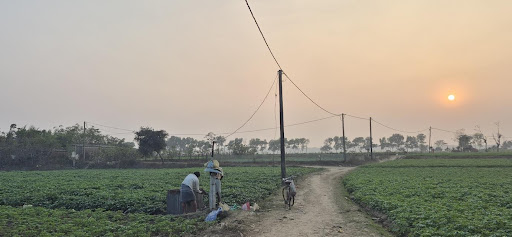
Women, by contrast, are less mobile—older women sell vegetables locally or do domestic work nearby, while younger women sometimes leave for the cities for education or after marriage.
Immigrants from Bangladesh now live in an informal settlement near the Damodar River, with no land titles or property papers.
As a settlement, however, Hotat Colony is informal, and most families here do not have land titles or property papers. Apart from this, their identity documents are often incomplete or contain misspellings. So, exercises like the SIR feel threatening to these immigrants because they demand kagojpotro or legal documents, which they never got.
“These houses were never formally allotted,” said Manik Bagdi, a member of the Belkash Gram Panchayat, under which Hotat Colony falls. “People settled here by getting verbal permissions or making small payments. Over time, it became a hamlet, but on paper it remained empty land.”
Some families bought small plots of land from landowners living nearby; others said they were allowed to settle here years ago with the support of local politicians. In both instances, they did not get any official documents.
As the settlement grew, it became permanent—in practice if not on paper. But the absence of formal land documents and property papers only deepened residents’ anxieties. While the names of some are on the final voter list, they are still afraid of the next government verification exercise.
Technically speaking, the SIR was meant to update the voter list and eliminate duplicates and the deceased. But in reality, the booth-level officers’ visits to the hamlet were anything but usual. As officers from the Election Commission of India (ECI) visited homes and checked voters’ information, rumours flew fast in the hamlet.
“Someone said that if your parents came from Bangladesh, they will question you,” said Ratan Mondal, a daily-wager in his thirties. “Another person said Aadhaar is not enough. We really don’t know what is true.”
Ratan, who found out this past week that his name was not on the final list, added, with some dismay: “If our name is not there, people will say we don’t belong, but we have lived here longer than many others.”
Some families heard about how people had left their settlements in other places to return to Bangladesh after ECI officials visited. Others worried that being marked “non-resident” by the officers could affect not just their voting rights, but also access to ration cards and welfare schemes—and importantly, their standing in the village.
This panic was not limited to those living in the hamlet. Men working in other places started returning for brief periods after the SIR began. Raju Halder, a contractor who currently works in construction in Kochi, returned to Hotat Colony after he heard about the door-to-door checks.
“Our migration is primarily economic, but the anxiety [and fear] around documentation travels with us,” he said over the phone. “Even from a distance, we were concerned about how the verification would affect our families and us both here and back home.”
A booth-level officer, who was assigned to the area, spoke to me on the condition of anonymity. He said, “There is tension, and some residents are worried that if their names are not on the voter list, it may affect their bank transactions or other activities. I explained to them that these are separate processes, but people are anxious.”
Take Shanti’s case, for example. Even though her name was on the final list, she was reminded of the fear she felt when she had to leave her home in Bangladesh. “We ran once because there was no land [for us],” she said. “Now we are scared we may have to run again, even after all these years.”
Women hardly spoke when the SIR officials visited the hamlet, and many did not even have voting cards. 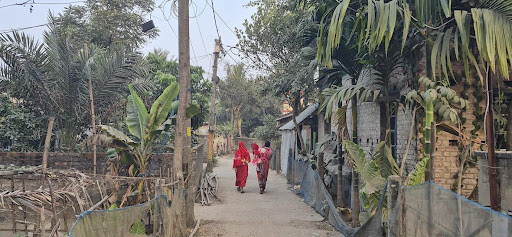
Women are invisibilised by the SIR
Like most of her neighbours in Hotat Colony, Parbati Das came here from Bangladesh more than 15 years ago. A widow in her fifties, Das managed to get a voter ID years ago (like others here) and an Aadhaar card too, but she has a different surname on each.
“I never thought these things mattered so much,” she said. “Now they [ECI officials] are asking for everything.”
Like Das, other women in the hamlet experienced the fear of the SIR more acutely. Most do not even have documents in their own names. Often, their voter IDs state that they are the “wife of” or the “daughter of” someone.
Also, spellings differ on different IDs, ages do not match, and parental documents are often unavailable. These inconsistencies, once unnoticed, have now become sources of anxiety for the women.
When the ECI officials visited their homes, the women usually stepped aside and let the men do the talking. The latter have always handled paperwork.
“They [the officials] ask questions so fast,” said Shanti. “I don’t understand what document they want or what answer is right. If I say something wrong, I am scared it will cause trouble later. So I stay silent.”
Like Shanti, Mala Mondal, too, did not talk when the authorities visited. A mother of three in her early forties, Mala came here from Bangladesh as a young bride. “The men went out to find work; we stayed in, lived on borrowed rice, took care of the children, and learnt to live quietly,” she said.
She added that women feel fear more intensely because they are the ones who have to make families stay together when things go wrong, when there are no more rations. “Men can go outside [to look] for work. It is we who will have to confront the children.”
Das echoed Mala’s sentiment. “If my name is removed [from the voter list], will my ration stop?” she asked. “What about my grandchildren?” Many women like Das were not fully aware of what being removed from the voter list means in terms of their electoral rights. They are more concerned about whether it will affect the stability of their lives, which they had worked so hard to build.
Children sensed the anxiety of their parents when they found out that names were missing from the final voter list.
As it turned out, Das’ name was not on the final list. “Will they say we have to leave India?” she asked, visibly worried. She said she did not know whom to approach about this or what to do to change it.
Younger women, who were born here or came as children, didn’t have IDs that reflected how long they had lived in the hamlet. Those who married early and moved to other villages somehow slipped out of the voter list, too. And some women just never got voter IDs or any form of identification.
Other women protected their identity documents in plastic bags to prevent damage from floods or fires. Some even borrowed money to make many photocopies of their IDs, unsure which one they would need when.
But all the women all had one thing in common: their incomplete, misspelt, or missing IDs made them invisible in a process like the SIR that demanded proof of identity and belonging.
“We are not asking for anything special,” Shanti said. “Just don’t make us feel like strangers again.”
Uncertainty’s psychological toll
Since the SIR began, many Hotat Colony residents have experienced sleepless nights, constant worry, and fear. “We don’t talk about it much, but the fear lives here,” Das said, placing her hand on her chest.
Elders were reminded of the time they had to leave their homes in Bangladesh; young people born here were afraid of what the future might hold. Gobindo Bapari, an elderly grocery shop owner, told this reporter that “this fear isn’t new. We had to leave everything once before. Now those memories have come back again.”
Parents worried that their constant anxiety was affecting their children, even though the latter didn’t fully understand it. “They ask us why we are scared,” Ratan said. “What do we tell them?” He spoke with sadness about how his daughter’s peers taunted her at school for being “Bangladeshi”.
Scholars have noted that bureaucratic practices such as the SIR, for instance, can cause long-term emotional harm, particularly to marginalised communities. Anthropologist Akhil Gupta, in his work on the Indian state, talks about how these processes, even those related to welfare, can become a form of everyday or “structural” violence. In the case of Hotat Colony, the SIR verification exercise created stress, uncertainty, and fear, besides deepening anxieties about belonging.
‘We don’t know about next time.’
When the revised voter list was finally published late last week, the fear in the settlement changed form. Even those who found their names on the list felt anxious, and almost everyone feared the next such verification process.
Not everyone waited to find out, however. Several families, villagers said, left Hotat Colony for Bangladesh, even before the final list was out. They were unwilling to live through weeks of uncertainty and rumours.
Those who stayed behind had varied experiences. After the draft list was published, members of at least two households saw that their names were on the list, but they had spelling mistakes. Others did not find their names at all.
Officials asked both groups to submit forms to have the spellings corrected or to wait for verification. These people were left in a state of suspension.
In some families, men’s names were on the list, but women’s were not. Younger residents felt a sense of unease. “Even if one’s name is there [on the voter list] now, we don’t know about next time,” Ratan said.
For these immigrants living along the Damodar River, the SIR did not end with the publication of a list. It reinforced an older truth: that their belonging remains conditional, tied to identity documents that are so very hard to get.
The names of all persons in this story have been changed.
~~~
Somnath Das is a researcher and writer with a background in development studies and social work. Deeply interested in urban studies and migration.