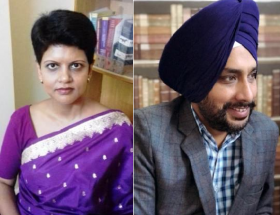

Istikhar Ali
The #JusticeMakers Mela at the Rajasthan International Centre in Jaipur, held on 6 December 2025, unfolded on a date that remains a raw wound in India’s political memory. It is a day when two sharply contrasting histories converge: the Mahaparinirvan Diwas of Dr B.R. Ambedkar—the architect of constitutional democracy—and the anniversary of the Babri Masjid demolition in 1992, which cemented a violently communal political era. For Pasmanda communities, this date is not simply an event in history but an ongoing fracture in lived reality: the constitutional promise of equality persists, yet daily life continues to be shaped by caste marginalisation and religious suspicion.
My engagement during the Mela was drawn towards the Behrupiyas—a group of traditional impersonator-performers who murmured, almost in hushed tones, that “no one talks or writes about us.” The pain in their concern was legitimate, certainly in a space committed to justice, rights and equality. Their performances stitched together drama, satire, and folk storytelling, while their bodies moved through multiple personae—Yamraj, ascetics, animals—mobilising an art form renowned for improvisational brilliance. They described their practice as hereditary, emerging from court performance and itinerant storytelling. These transformations served, more often in the past, not only as entertainment but at times as intelligence and communication strategies in older political contexts.
Yet, behind this sparkling array of costumes was a deep and underlying fatigue. “It is not livelihood anymore; it is only survival,” one performer said. The community receives neither institutional recognition nor financial support. Most live in small towns and migrate seasonally to cities where opportunities remain precarious. The real crisis, they emphasised, is generational. “Our children do not want to continue,” an elderly performer explained, “because this art gives neither dignity nor income.” What becomes visible here is not only cultural decline but a psychologically exhausting landscape in which elders feel guilty about passing on a heritage that no longer protects the younger lives. The fading of skill is inseparable from the fading of confidence in the future.
These Behrupiyas belong to the Nakkaal-Bhand community, listed under Muslim OBC in Rajasthan. They recalled barren land distributed to their grandparents during the zamindari period—without paperwork and no legal recognition—leaving them permanently unsettled. Without land, there is not only economic precariousness but also a continued psychic duress, internalised as a feeling of being “unanchored,” and unrecognised by the state.
They insisted that caste discrimination intensified after Covid, but on deeper probing, their accounts revealed something sharper: communalisation has reinforced caste-based marginality. “We struggle not only with art, but with existence,” said one performer. It is a distinctly Pasmanda condition, where caste and communal discrimination interlock to create unemployment, documentation anxiety, and chronic psychological distress. Many spoke of constant worry over their children’s education and their own old age without pensions, healthcare, or community infrastructure. Elderly Behrupiyas live with the distress of watching a lifetime of knowledge become economically irrelevant, in the absence of emotional support or social security.
“Art has no religion,” one asserted, “but politicians have made religion out of everything.” For Pasmanda communities, this erasure is double-edged. Muslim identity gets flattened into a singular religious minority while caste-based Muslim labour becomes invisible in public discourse. Lower-caste Muslim artistry—music, weaving, performance, carpentry—disappears under majoritarian suspicion and is simultaneously unacknowledged by dominant Muslim elites. This invisibility is not merely cultural; it corrodes psychological self-worth. Many performers expressed a growing sense of not belonging, replaced by continuous fear, shame, and uncertainty.
Citizenship anxieties compound these pressures. Being semi-nomadic, they lack fixed addresses and therefore face enormous bureaucratic obstacles. The stress of constant documentation—for PDS rations, Aadhaar, Special Intensive Revision (SIR), and citizenship proofs—exposes them to surveillance and humiliation. “We were born and brought up here for generations, but now we must prove it every day,” one elderly performer explained. The fear of being categorized as undocumented or “undesirable” produces severe psychological distress, especially among older members whose memories hold India as home but whose papers cannot demonstrate that belonging. A community without documents is treated as a community without legitimacy—leading to relentless anxiety and trauma tied to existential insecurity.
Ambedkar envisioned a democracy built upon fraternity, the annihilation of caste, and substantive equality. After 1992, majoritarian nationalism redefined citizenship through religious belonging. In such a political environment, Pasmanda Muslims not only lose livelihoods; they lose psychological security. The mental health consequences are grave: chronic stress, a deep-seated humiliation, the loss of intergenerational confidence, and a growing feeling of being “unwanted citizens.” Many described constant police verification, suspicion in public spaces, and the politicisation of their identity—creating a suffocating emotional reality that pushes children away from heritage and leaves elderly performers anxious and helpless.
The psychological burden is most vivid among elderly Behrupiyas who continue performing despite physical strain. They spoke of routine humiliation, anxiety related to police questioning, difficulty in accessing healthcare, and the fear of dying without recognition. These are not mere economic concerns, but emotional scars created by an unending struggle for legitimacy.
When one performer concluded, “We do not want sympathy. We want recognition—as citizens, as artists, as human beings,” it resonated as a plea for psychological wholeness. Citizenship is not only a matter of documentation; it is the emotional assurance of belonging.
Remembering 6th December, therefore, cannot be reduced to a symbolic ritual. To remember Ambedkar is to foreground the everyday psychological pain of those most harmed by caste and communal majoritarianism. Pasmanda communities remind us that democracy is not measured by constitutional text alone, but by the emotional security available to its most precarious citizens.
Their dying art and their enduring distress testify not only to cultural loss but to democratic depletion. Whether Indian democracy survives as a space for constitutional belonging or collapses into a majoritarian order will be determined not by political statements, but in the daily emotional lives of those who endure the double wound of caste exclusion and communal suspicion.
~~~
Istikhar Ali is a DAAD fellow at the Centre of Modern Indian Studies (CeMIS), Universität Göttingen and PhD scholar at the Centre for Social Medicine and Community Health (CSMCH), Jawaharlal Nehru University.