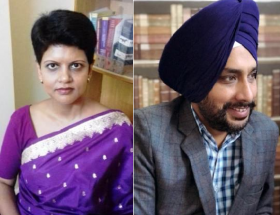

Ringngheti Khenglawt
. . . in 1947 the British empire handed us over to the Indian government and set sail towards their homeland. At the year 1958 and 1959, mautam – the famine caused by the flowering of bamboos and rapid increase of rat population, made us realize that we were just a guest at a stranger’s land and lack of help and aid from our host, the Indian government, while we were at our worst times, awakened and enticed the patriotism of the mizos. Our very own inheritance of total freedom which was once lost – Mizoram has awakened to regain it back.
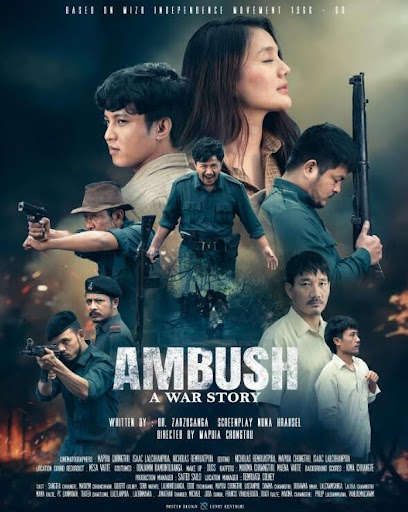
The narrator solemnly states the above in the opening lines of the 2-hour 52-minute, bilingual (mizo and hindi) film Ambush (A war story) (Chongthu, 2023), written by Dr Zarzosanga, a political scientist specializing in the area of Mizo National Front (MNF) insurgency, and directed by the highly acclaimed mizo filmmaker Mapuia Chongthu in 2023 (Image. 1). This sets the stage for deeply traumatic, personal and collective experiences of the mizos who were subjected to postcolonial oppression and marginalization from the state, eventually leading to the rise in nationalist aspirations.
During the years of rambuai (translating to disturbance of land) (1966 to 1986) or the insurgency period, brutal counter-insurgency measures were employed by the state in the Mizo hills, such as aerial attacks and forced relocations to authorized camps called the Protected Progressive Villages (PPVs), justified in the name of maintaining national security. Bhardwaj (2023) stated that a report on 9 March 1966 by the Hindustan Standard quoted the then Prime Minister Indira Gandhi denying claims of the Indian Air Force (IAF) dropping bombs on the land and claimed that they had only dropped supplies and men. But the lived realities of the mizo people claim otherwise. In August 2023, during a debate on the no-confidence motion in Parliament, Prime Minister Narendra Modi questioned the opposition by bringing up Congress attacks on the helpless citizens of Mizoram on 5 March 1966. This move was on the pretext of sly political maneuvering against the opposition and not voicing the sufferings of the mizos who have lived with this collective trauma till now. Hence, in the dominant national discourse, narratives of the mizos’ suffering during Rambuai are often denied, ignored, or manipulated.
In extension, the grouping of villages, which has been largely ignored in mainstream national political memory, was characterized by surveillance, imposition of curfew, starvation, forced labor, sexual violence, and constant search operations (Sundar, 2011). They were in the form of ‘prison aesthetics with watchtowers, barracks, and barbed wire perimeters’ and could only be entered with an identity card issued by the state (Roluahpuia 2023, p. 121). In 1968, Suakliana, a famous mizo composer, even wrote in a song — ‘In all life under heaven, the grouping of villages is the sorriest thing’ (translated in Sundar, 2011).
Inspired by real-life experiences during rambuai, Ambush locates the silenced history of the ordinary mizos who never asked for this conflict but were caught between state violence and insurgency from their people. The film is set in Zopui village, where surrounding villages were forcibly relocated after Indian security forces burnt down their houses as part of counter-insurgency measures. Even though the film sets off with the parting of two brothers, Thartea (played by Sangtea Chhangte) and Captain Zohmaa (played by Gilbert Colney) – the former who disagreed with the violence of Mizo National Front (MNF) uprising and the latter, who volunteered in the MNF special forces, it delves beyond ideological differences between kins. Ambush uncovers the collective trauma of the mizos by narrating the daily experiences of the villagers of Zopui who were constantly watched with suspicious gazes and subjected to extra-judicial violence by Indian security forces on one hand, and on the other, pressured by the MNF insurgents, their own people to provide food and information.
The central narrative of the film follows the capture and torture of Major Lalngura (played by Sena Ngente), the leader of the MNF special force, who was hidden at the army camp in Zopui village. Since he had access to inside information regarding the operations of the Indian military all around Mizoram, his imprisonment and rescue remain the focal point of the narrative, which intensified the sufferings of the ordinary villagers. Amidst all these, we also see fragments of normal lives such as the youth still engaging in the mizo courtship practice called inrim, consuming alcohol and getting drunk, familial bonds between mother and son (as in the case of Thartea and his mother), humorous banter between friends and family, etc.
At the heart of the film, perhaps, is the figure of the village head known as the Village Council President (VCP) (played by R. Lalnuntluanga), whose leadership is profoundly vulnerable as he is portrayed as a reluctant mediator, forced to navigate the demands of the Indian security forces and the MNF, whilst having to consider the survival of his people in the village. From the film, it becomes evident that survival under such an oppressive regime was impossible without loss, betrayal, and death.
Ordinary mizos and their layered struggles: Torn between state violence and MNF insurgents
As mentioned previously, the VCP figure becomes a symbol of ordinary mizo’s dilemma. In the first village sequence located in Bungpui village, an MNF volunteer was sent to the VCP’s house to gather food since they had gone without it for two days, while thirty waited on the outskirts. In the VCP’s private exchange with his wife, we learned about the impossible choices they had to undergo when he said, “If we reject their request, we will have to suffer the consequences. But if we give them food, I am afraid the Indian armies will hear about it. I really don’t know what to do”. Even when his wife retorted, “But we barely have food for ourselves”, his helpless resignation, “Yes, I know. But we have to stay alive”, eventually got him shot to death by Officer Saxena (played by Eddie Tochhawng) of the Indian army, who was informed about the VCP aiding the MNF through the village informant. The fate of all VCPs was sealed from this scene.
The central VCP of the film Pu Sapa (played by R. Lalnuntluanga) further extends this predicament as a key figure caught in an endless moral torment. This culminated when the Commanding Officer (CO) (played by the director Mapuia Chongthu) demanded ten to fifteen young men to serve as coolies in a convoy to Aizawl, where Major Lalngura would also be transported. The VCP and parents knew that this convoy would likely be ambushed and their children would be used as human shields by the Indian army. The dialogue between the VCP and his wife clearly brings out this tension and dilemma when he stated – “If I send the rest of the other children while my son stays here safe and sound, how will I have the courage to face the villagers again?”, to which his wife asked in anger and desperation- “Is your status and work more important than your own son’s life? Aren’t you his father? What kind of father are you?”. In this moment, we witness the intimate cost of his duty as a VCP, where even the private space of the family turns into a site of struggle- an impossible choice between his duty, his people, his role as a father, and even as a husband.
Ambush also humanizes the role of kawktu (informants or spies) who are often condemned but are rarely understood. In one scene, Vanzika (played by Duhawma Hmar) is seen collecting rations provided by the state, only to receive spoiled rice infested with rat droppings. The ration officer informed him to appease the CO if he wanted better food, thus revealing how survival under the PPVs is characterized by coercion, betrayal, and humiliation. When his information led to the execution of an MNF volunteer who was tortured and forced to dig his own shallow grave, Vanzika was broken and horrified with what he had witnessed, haunted by the last words of the dying man – “For God and our nation”. Through this, we see the ethical dilemma of the informants, who bear the weight of their complicity in violence against their own people and also compelled to feed their families.
Studies on rambuai history state that even though common people may not have supported MNF ideologically, due to the horror they had faced within the confinements of the grouping centers by the Indian army, their support increased as a matter of doing justice to the sufferings of the people (Sundar, 2011; Pachuau & Sadan, 2016). The brutal rape of Muani (played by Lalruatpuii), a deaf and mute woman, by men in the Indian army and the subsequent response from her brother Rammuana (played by Phillip Rammuana) reveal the same. When she returned to the village traumatized after her assault, the villagers, horrified by her sight, could do nothing but look at the perpetrators in revulsion. Consumed by grief and anger, Rammuana sought out an MNF volunteer on the outskirts of the village, telling him, “I am not an MNF volunteer, but we have a common enemy . . . If I can help in any way, I am willing.” Thus, this reveals that even ordinary mizos began to see acts of resistance as a moral response to injustice and thereby, increasingly regarded the Indian army as the bigger enemy.
Through these experiences, Ambush highlights the ethical dilemma, sacrifices, humiliation and shifting loyalties that is shaped by survival. It shows how ordinary mizos navigate the impossible choices that they faced under violence and oppression and reveals how even perceptions of justice and resistance change under such regimes.
The politics of cultural trauma and talking back through cinema
When we see contemporary, mainstream discourse in public platforms on MNF insurgency and counter-insurgent measures employed by the state, it often centers around the Aizawl bombing of 1966 by the IAF. Experiences of the villagers within the grouping centers have often been left out of these discourses, although they have been addressed in several academic and creative writings. In narrating the stories of the daily struggles of mizos under horrific conditions of the grouped villages, Ambush highlights the cultural trauma of mizos at the micro and rural level and not just the urban as a site of violence in popular cultural texts. Further, the film shows that oppression was not solely inflicted by the Indian security forces. Ordinary mizos also lived in constant fear of the MNF insurgents. By portraying these experiences on screen, the film talks back to dominant narratives, giving voices to the sufferings of ordinary people under extraordinary violence and making cinema a medium of witnessing and reclaiming the often-sidelined voices.
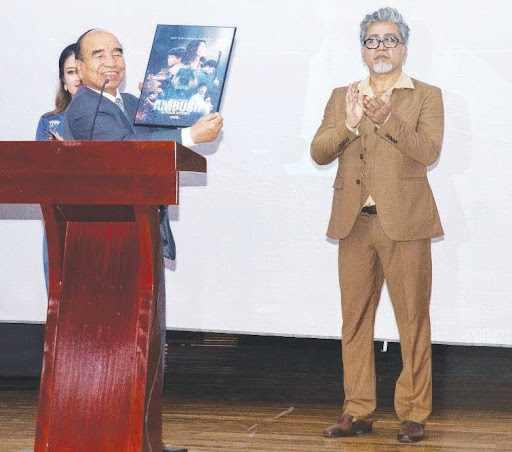
On 5 October 2023, the then Chief Minister of Mizoram, Zoramthanga released the film (Image. 2.). What is quite interesting about this is that he himself was an MNF volunteer during the insurgency, adding a layer of political and cultural significance. As both a former insurgent and as a contemporary political head within the Indian state, his endorsement of the film symbolically signifies and legitimizes the lived experiences of the sufferings of ordinary mizos under the brutal grouped villages and the moral ambiguities of the insurgency. Further, the director Mapuia Chongthu stated that Ambush is not just entertainment but a cultural text of information for younger generations who had not experienced the horrific rambuai (The Aizawl Post, 2023). This positions Ambush as a medium of mediation between politics, cultural memory, and public recognition. The film represents how cinema can operate as a medium of talking back, challenging reductive dominant discourses, speaking for the silenced, and asserting the voice of an already marginalized community within the nation-state.
Post-conflict reckoning and mizo creative industries
The process of circulation of the film also shows challenges faced by mizo creative industries in the post-conflict context, where one sees the intersection of market forces and political apprehension. In one of the leading vernacular newspapers of Mizoram, Vanglaini, Mapuia Chongthu stated that he had approached several national over-the-top (OTT) platforms for digital distribution of the film (2023). However, since the film focused on insurgency and portrayed the Indian army in a negative light, it was rejected because of concerns over political apprehension and potential backlash. Thus, there is still ongoing tension between post-conflict states and narratives that challenge the dominant framework, especially in instances where state power is questioned and critiqued.
Eventually, the film was digitally distributed on Lersia Play, a mizo OTT platform for mizo content. While this provides a space for mizo narratives in streaming platforms, its reach remains largely within the mizo audiences. In this sense, even though dominant narratives continue to be challenged, their circulation and reach remain limited. Hence, we find that there are structural barriers that prevent counter-narratives of the marginalized from entering a wider national discourse. The rejection by national OTT platforms tells us that there is still continued silencing and sanitization of contentious histories in an otherwise ‘democratic’ nation-state.
This dynamic shows us post-conflict reckoning, that, despite a formal resolution of the insurgency in 1986, cultural production and creative industries largely remain entangled in a broader structure of power, censorship, and negotiation. In all these, despite its limited reach, mizo OTT platforms like Lersia Play act as a site of cultural memory, resistance, and assertion while contesting the silence and erasure that is imposed by mainstream cultural media/politics.
Conclusion
The film Ambush (A war story), therefore, reflects mizo cultural trauma and is a testament of what a mizo scholar Roluahpuia (2018, p. 39) notes as a site of ‘memories that remain unsettled, and tensions that remain unresolved’. The process of its circulation also tells us both the fragility and resilience of mizo creative industries in the post-conflict context.
References
Bhardwaj, A. (2023, August 11). When Indira Gandhi faced raging mizo insurgency — IAF’s 1966 Aizawl air strike & birth of a state. ThePrint; theprint. https://theprint.in/india/when-indira-gandhi-faced-raging-mizo-insurgency-iafs-1966-aizawl-air-strike-birth-of-a-state/1710024/
Chongthu, M. (Director). (2023, October 5). Ambush (a war story) [Lersia Play]. Leitlang Pictures (Video & Film Production House).
Pachuau, J. L. K., & Sadan, M. (2016). The social memory of the mizo buai: Some comparisons with the Kachin conflict. In M. Sadan (Ed.), War and peace in the borderlands of Myanmar the Kachin ceasefire, 1994–2011 (pp. 434–457). NIAS Press.
Roluahpuia. (2018). Memories and memorials of the mizo national front movement problems and politics of memorialisation . Economic & Political Weekly, LIII(25), 38–45.
Roluahpuia. (2023). Nationalism in the vernacular. Cambridge University Press.
Sundar, N. (2011). Interning insurgent populations: The buried histories of Indian democracy. Economic and Political Weekly/Economic & Political Weekly, 46(6). https://www.epw.in/journal/2011/06/special-articles/interning-insurgent-populations-buried-histories-indian-democracy
The Aizawl Post. (2023, October 7). Zoram buai behchhan film siam. Theaizawlpost.org; The Aizawl Post. https://theaizawlpost.org/amp/zoram-buai-behchhan-film-siam/
Vanglaini. (2023, October 5). Thalai – ngaihven hlawh “Ambush” tlangzarh dawn ta. Vanglaini.org. https://www.vanglaini.org/thalai/102006?date=2023-10-05
~~~
Ringngheti Khenglawt is a Mizo PhD researcher in the Department of Sociology, Christ University, Bangalore. She is interested in the areas of sociology of media, popular culture, masculinity studies, and indigenous studies.