Dr Ratnesh Katulkar
A river remains alive only so long as fresh water continues to flow through it. The same principle applies to language. Language is never static; it evolves with time. Its vocabulary, sentence structure, and modes of expression continually change. Whether one considers Hindi, English, or any other language, it becomes evident that literature written in the nineteenth century is often difficult for contemporary readers to approach without assistance.
For this reason, responsible publishers of classical literature frequently present ancient works in a renewed form, adapting their language, style, and presentation to the needs of modern readers. Such efforts enable timeless ideas to remain accessible to new generations.
When we turn to Buddhist literature, however, we find that relatively little attention has been given to this task. Many texts continue to be published in styles that remain largely unchanged from earlier translations. Regrettably, this has contributed to an increasing distance between younger readers and the rich intellectual heritage of Buddhism.
One remarkable work that has suffered from this situation is the Milinda Pañha (Questions of King Milinda). This extraordinary text preserves a series of profound dialogues between King Milinda and Venerable Nāgasena, offering readers an accessible gateway into the heart of Buddhist philosophy through reasoned inquiry and debate.
Today, this book can be found in many Buddhist households across India. Yet experience suggests that, although it occupies a place of honour on many bookshelves, it is seldom read in its entirety. Many readers begin it with enthusiasm but fail to complete it. This is not mere excuse-making; it is a practical reality. The difficulty arises largely from an archaic style of translation and a language that often feels distant from contemporary readers.
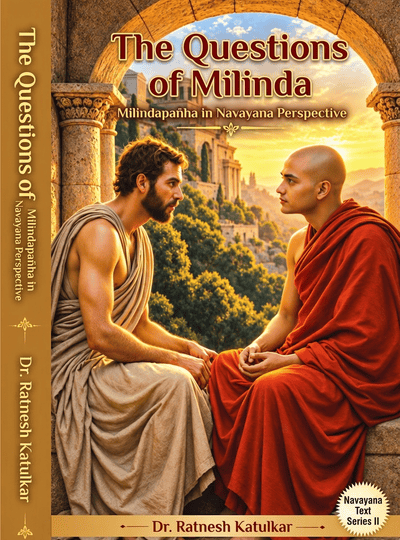
As publishers, we felt it insufficient merely to lament this situation. Instead, we resolved to seek a constructive solution. Our volume, The Questions of Milinda: Milindapañha in Navayana Perspective, represents the second step in that endeavour. The first was Navayāna Darśana: A Modern Interpretation of the Buddha’s Teachings, which presented Buddhist philosophy in a simple, rational, and contemporary style. The enthusiastic response it received, leading it nearly to go out of print, encouraged us to continue this work.
The present book is not a direct translation of the original Pāli text. Rather, it is a careful reworking based upon a comparative study of English, Hindi, and, to some extent, Marathi translations. Many existing versions contain accounts of previous births and other traditional elements that appear difficult to reconcile with modern scientific understanding and with claims concerning the rational and humanistic character of Buddhist philosophy.
In this edition, Author Ratnesh Katulkar has sought to remove such accretions and reinterpret the text through a Navayāna perspective, presenting it in a clear, modern, and accessible form for contemporary readers. Yet this undertaking presented a significant challenge. The original questions of Milinda and the replies of Nāgasena could neither be arbitrarily expanded nor fundamentally altered. How, then, could they be made more approachable?
The solution adopted was both simple and effective. The original dialogues have been preserved with only minimal modifications, mainly involving language and presentation. However, following nearly every question-and-answer exchange, explanatory sections have been added in which the discussion is interpreted afresh in the light of modern knowledge and contemporary concerns. In this way, the text has been connected to present realities while preserving the spirit of the original dialogue.
We are confident that this approach will appeal both to readers already interested in Buddhist philosophy and to newcomers seeking an accessible introduction to the Dhamma.
It is only natural, however, that some readers deeply attached to traditional interpretations and inherited assumptions may not feel entirely comfortable with this presentation. Any attempt to revisit established traditions is often met with resistance. Yet the Buddha’s path itself is one of inquiry, reflection, and continuous investigation. Following the spirit of the Kālāma Sutta, it encourages individuals to examine truth for themselves rather than accept doctrines solely based on authority or tradition.
Our purpose is not to provoke those committed to conventional views, but to ensure that younger generations become active participants in the Buddhist intellectual heritage. For that reason, it is perhaps best to pay little attention to reactionary criticism. Navayāna, after all, resembles an elephant that continues steadily on its path without being distracted by passing noises. This book is simply another step in that journey.
History repeatedly demonstrates that every significant intellectual and social transformation faced opposition in its own time. Yet it is often these very transformations that later shape the course of human civilisation. Generations afterwards, historians frequently look back with surprise at the resistance such movements encountered.
Navayāna is part of that continuing tradition of renewal. The flame first kindled by the Buddha illuminated vast regions of the world in the age of Emperor Aśoka. Though dimmed during periods of decline and reaction, it was rekindled in modern times by figures such as P. Lakshmi Narasu, Dharmanand Kosambi, and Dr B. R. Ambedkar, inspiring countless thinkers and reformers across the world. Each of these individuals encountered hostility from conservative circles; therefore, criticism of our own efforts should come as no surprise. Indeed, our author often remarks that a positive mind can transform even hostility and irritation into a source of strength and motivation.
This book was not written in isolation. The entire manuscript was taught and discussed online with students over an extended period. Every dialogue, criticism, observation, and suggestion emerging from those discussions was carefully considered and incorporated where appropriate. The final text was subsequently reviewed and approved by the wider Navayāna study group. Consequently, this volume should not be viewed merely as the private opinion of its author. It is, rather, a collective expression shaped through dialogue, study, reflection, and collaboration among the students of Navayāna. We sincerely hope that readers will find it worthy of their expectations.
We humbly request all readers to share their reflections, suggestions, and critical assessments after reading this book. Your thoughtful responses will guide and inspire our future work.
Bhavatu Sabbamaṅgalaṃ
Navayāna Prakashan
Nashik, Maharashtra
Book Title: The Questions of Milinda: Milindapañha in Navayana Perspective
Author: Dr Ratnesh Katulkar
Publisher: Navayana Prakashan, Nasik
Page count: 165